Nailed it on the head! Everyone wants someone else to pay for services. Nobody is saying "Raise my taxes - I appreciate these services". We're all complicit.
Very true. Coming from Quebec, Canada, I actually say that. It's more ingrained in our culture that what we are taxed for is services that benefit us all and that makes our societal environment more enjoyable.
Now in the US, I can't seem to find anyone who think this. My biggest issue is that I can't even find anyone who thinks that the government is the people. Everyone seems to think of the government as this black box that has a mind of its own and inflict laws and rules upon us. While I'm much more used to the common thinking that the people rule, and the government simply enact our rule. We elect it, we pay for it, and therefore it simply does what we elected and paid for it to do.
I'm not sure what makes up that difference, but it could be the bi-partisanery. It's a shame too, because it often fails to capture fine grain requirements. Like say I wanted a very liberal economy, while keeping gun rights strong and conservative norms in place? Or the other way around? There's no kind of choice like that. So you lysine end up for choosing based on your top issue only.
It's a pro-private, anti-democratic push by chicago school, objectivists, and other groups, to essentially slander civic institutions as terrible and "privatize" them with capital extracting robber barons. "Government" is a 4 letter word and some people are insufferable in their hatred for it - thinking that some private selfish interest of people would magically make the world ... look, it's all preposterous ... it's apologetics and denialism wrapped in the religious fervor of a mythical free market.
A huge part of the problem is that people think one system is better than the other when it's really a spectrum where both extremes are absurd. Suppose you want to have some roads, how do you do it?
a) Pure Communism. The state builds the roads. The state needs road workers and workers need food so the state grows food. The workers need steamrollers so the state manufactures steamrollers. The workers need asphalt so the state mines gravel. The entire economy is centrally planned and collapses like the USSR.
b) Pure Capitalism. A private company owns the road. You need their permission to leave your house, take deliveries, receive an ambulance, connect to the power grid, etc. They charge what the market will bear. Everyone becomes a serf of the road company.
c) Capitalist Social Democracy. The state collects taxes and takes bids for private contractors to build the roads, which the state then owns and allows all people to use at no charge.
C can be a problem. It's how the military industrial complex that Eisenhower warned us about is structured.
"C" is what leads to things like corporate bail outs.
Parenti talked about this with Conrail in the 80s. It was a train system that was put in public trust because it couldn't make money in the 70s. Then after the public made it profitable, under Reagan, it was reprivatized - not because it didn't work, but because it did work.
"C" goes beyond this in corruption. You get "compromises" where you have private health-care paid by public taxes (obamacare) or medicare part D with prescriptions being covered but the government forbidden from negotiating the prices. Or you get private for-profit schools able to use government loans for tuition and getting to the corrupt state of affairs we have now.
No, "C" is a terrible idea because it's a giant funnel into the hand of corrupt bank accounts - it promotes the state to prop up forms of dysfunctional capitalism.
In fact if you look at the total tax burden by country, including state tax and other things (https://en.wikipedia.org/wiki/List_of_countries_by_tax_rates) You see that the US is higher than places like Luxembourg, Denmark, the Netherlands - way above France and the UK. We pay more and get less, and it's all because of "C".
But all those other countries you mentioned are also C, in a way bigger way. The US leans more towards B, in actuality, versus those other countries. Are you saying A is the solution?
Not really. If we can agree that people respond to incentives, then we should make sure the incentives of how we constitute civil society align with their purpose and that the purpose doesn't get perverted through gamesmanship.
For instance, arguably schools are primarily for education. So increasing the access to and quality of education is probably a decent goal.
For profit systems certainly have increased the access to, but arguably deceased the quality of, and arguably education is only incidental to the true project, which is profit.^1
It's this problem, where we entrust civic needs in private hands and hope the needs are satisfied incidentally.
The problem with communism is that it's somewhat the same thing. Instead of economic capital, they fight for political capital using a similar perversion of incentives.
I don't think there exists a Grand Unified Equation that works for all civic needs and I don't think that the best answers already exist.
Instead, I think it should be openly and honestly researched like all other sciences and leave the sportsmanship and team cheering world it currently occupies.
----
[1] For-Profit schools may have their place. I don't know much about auto mechanics or plumbing, but I can imagine a certified for-profit program would be a fine way to do this. I can also imagine them cutting costs, paying off inspections, and passing everyone so nobody stops paying the tuition. The goal is to not make ripping people off and cheating them out of an education such a profitable and incentivized thing to do.
Suppose we have the government build the roads. Are they also going to manufacture their own steamrollers and mine their own gravel all the way down the stack? If so you're at Pure Communism. If not then you still have exactly the same problems to deal with when the government goes to buy those things from private industry.
The thing you're really criticizing is government corruption. A corrupt government will screw you no matter its ideology.
Stepping back, it's the capital doing the corrupting. The private/public interplay creates incentives to pilfer the public coffers in exchange for campaign contributions if you stick around and a cushy job if you don't.
It is the exploitation of government that is inherently corrupt and the exploiter who is the corrupter. The commingling of such interest leads to the pursuit of private profit in the name of the public trust.
The calls for less government are constantly in the name of removing the watchdogs and observers, the enforcers and regulators - the only counterbalance to this incestuous relationship.
They call for a removal of oversight to alleviate corruption and a forfeiture of authority and action to increase responsibility.
The only perplexing thing is how so many continue to be startled and bewildered by the direct consequential policies of encouraging such statecraft.
I think the biggest issue is everyone thinks they know what would work, when there's no single model that can capture the complexity of real life. Just as we don't even have a unified model of physics, much less is there an obvious way to run a society.
The thing in the US is that I don't hear anyone talking about what they're even trying to accomplish. Do citizen even agree there? Why isn't there a conversation about that?
If we had a testing function, something we all agree on that this is the outcome we all or at least the majority wants for the society we're in.
Then we'd have a way to judge how a government did, or what worked and what didn't, and we could focus on iterating and improving our output towards what we all want.
Unfortunately, I think some minority groups, often corrupt, often in power or rich, they spend a lot of money and effort to switch up the conversation away from what people want and towards what they want, and then they have massive teams working to realize their vision.
a) it's ridiculous to summarize the collapse of the USSR as being due to centralized planning. There were grocery stores sitting empty and corruption saw wealth going towards fewer and fewer hands. Plus they were more of a totalitarian dictatorship than communism
b) dramatized perhaps but ok
c) layers on ridiculous rule after rules, hands out contracts then only to those than can afford to abide all the rules (conveniently they're also related or friends with those people), which is started layering on after its propaganda engine convinced the public it was to prevent government doing a bad job of spending their taxes. Then fast fwd to 2016 and wealth inequality has gotten so bad the whole thing looks rather untenable without a serious rethink
In a) and c), corruption is inescapable. It is an unavoidable consequence of centralized power, not something that can be fixed with endless (corruptible) oversight committees or particularly prescient design. It is cot an implementation bug, it is a bug in the spec. Meanwhile in b), corruption is a feature that looks like a bug. Self-interest is harnessed instead of ignored. And while b) certainly has its problems (one of which, infrastructure, is noted above), corruption is not one of them. However, despite its problems, the lack of central authority in b) has caused the single greatest reduction in both poverty and mortality in the history of mankind.
Well, you'll need to write a pretty great proof that it was exactly that which caused the reduction in poverty and mortality. You'll also have to prove that there even was a reduction in both, and you'll need to be more precise about where and when exactly.
I tend to belive it was more the morals of the age of enlightenment and the progress in modern science, which was probably accentuated by those same morals which caused all that. And today, I see a move away from those morals, which is a little alarming I think. But I'd similarly would need to come up with a pretty good proof for all that, as nothing is obvious when so many variables are at play.
I agree, at least in part, that the progress of the modern era was indeed due to both modern science and the principles of the enlightenment. However, I do believe that the success of both modern ethics and science can ultimately be attributed the advent of emergent phenomenon (of which capitalism is the economic sort), which is the eventual conclusion of free society.
In the case of science, this is the idea of the "marketplace of ideas" that is often talked about today, but really coincided with the enlightenment. Scientific ideas compete in the literature for dominance, and that grow the most acceptance over time eventually dominate. Both Newton's calculus and gravitational theories proved to be subject to quite a bit of criticism (from Gottfried Leibniz and Robert Hooke, respectively), and of course Newton's gravitational theory has become dominant, though I have heard that the calculus we learn today is closer to that of Leibniz than that of Newton. Likewise, Darwin's theory of natural selection was subject to intense a persistent criticism for nearly 100 years -- Darwin's Theory of Natural selection was published in 1856 and the Scopes trial was not decided until 1925, and the Supreme Court only struck down laws outlawing teaching of evolution in 1968. Today, of course, countless scientific theories are competing for dominance in the scientific literature across the world -- a process that has been fundamental to the monumental scientific gains we have made since the time of Newton.
Likewise, secular theories of morality have been almost entirely emergent in nature. Adam Smith first proposed that morality was the consequence of compassion, learned by each of us as we grow up and figure out that making others happy makes us happy, and seeing misery makes us unhappy (he called this "mutual sympathy of sentiments"). He claimed that as we grow, each of us comes up with our own moral code based on what we discover to cause mutual sympathy of sentiments, and that society's moral sense is derived from each of our individual moral codes. In fact, Adam Smith first used the term "the Invisible Hand" in his "The Theory of Moral Sentiments" to describe how societal morality is derived from individual moral codes. An example of this in our lifetime is the growing acceptance of lgbtq people in the west, or in the generations before us, the about face in the moral attitude towards race. Today, that arguments is carried on by the likes of Steven Pinker, who claims that our sense of morality is continually moving towards acceptance and away from violence, which he attributes to commerce (which forces people to interact with each other), and centralized government, by forcing people to act as people of a court rather than as warriors -- though I might prefer the term civilized government.
That said, none of these ideas are even slightly novel. Lucretius first expounded on them in his "De Rerum Natura", and obviously the giants of classical liberalism explained them in much greater depth. Charles Darwin was brought up in the tradition of the Scottish enlightenment thinkers, and very much surrounded himself with the ideological successors to classical liberalism and, in particular, David Hume. In the economic sphere, Hayek devoted his entire life to the idea of emergent phenomenon. And lastly, most of the examples here are taken from "The Evolution of Everything" by Matt Ridley.
Privately owned things have been around as long as private property: ~20,000 years. Greed predates that quite a bit more - let's cut it off at the rise of modern humans: ~70,000 years.
Yet the "greatest reduction in both poverty and mortality" is a relatively recent phenomena happening during the rise of publicly accountable civic institutions. [1]
To then attribute this with something that did not lead to this process in the first 69,800 or so years is, in my opinion, pretty poor logic.
----
[1] In fact, in Africa the greatest rise came after the decolonization post-ww2 and the establishment of states and representative governments. To say the predecessor extractive industries under colonialism weren't "capitalist" is also, quite incorrect.
I think this is a rather elementary (and Randian) view of capitalism. I don't know of any serious proponents of capitalism who claim that pure greed and self-interest is desirable. It is also a mistake to equate the existence of private property, or even the existence of limited free trade in primitive society with the effect of a society that is fundamentally capitalist in nature. And mercantilism (aka "crony capitalism") isn't capitalism either. Capitalism isn't the same thing as "some trade exists, that is somewhat free, for some people, sometimes".
> it's ridiculous to summarize the collapse of the USSR as being due to centralized planning
Is it? These things were predicted long as a consequence of state socialism long before the USSR existed, and we still don't learn our lessons (venezuela)
Eh, c in many cases includes govt built & maintained toll roads, cause as it turns out roadways can cost tens of billions to build. Makes rail look cheap in comparison!
Toll roads are very stupid. The cost of the road is building the road, not driving on it. Even the maintenance cost is predominantly weather-related. A toll road pays the same construction cost and then gets less use out of it because the tolls discourage people from using the road.
Tolls have the pricing wrong. There is no unit cost so the problem is apportioning the fixed cost. A platinum mine clearly derives more profit from the road than a potato farmer, so why should we charge per truck (tolls) rather than per dollar of profit (taxes)? All that does is price low-profit (i.e. more efficient) enterprises out of the market, which is exactly what we don't want.
In addition to that we already have a tax collection infrastructure which is not going away, but collecting tolls would require a redundant toll collection infrastructure on top of that.
> Congestion tolls are great -- they encourage better utilization of a scarce resource (the road at a certain point in time).
Congestion tolls are the rich man's way of getting the government to build enough infrastructure for them without having to pay for enough infrastructure for everybody.
If there is congestion it's either because you don't have enough roads or because you don't have good enough mass transit which is dumping the load it should be carrying onto the roads.
For any given amount of infrastructure, proper pricing makes its use more efficient (of course, minus the inefficiency of actually implementing tolls), by shifting demand towards less busy times or encouraging use of mass transit and pooling. In a lot of jurisdictions it's essentially impossible to build enough road so there is zero traffic, because buildings can grow upwards but roads cannot.
Your point about the rich getting infrastructure seems like a non sequitur here. It's voters' job to get their representatives to build enough infrastructure, not just the rich.
I agree that congestion tolls are somewhat regressive, but the solution is to have a progressive tax system, not to avoid efficiency taxes.
> For any given amount of infrastructure, proper pricing makes its use more efficient (of course, minus the inefficiency of actually implementing tolls), by shifting demand towards less busy times or encouraging use of mass transit and pooling.
You also have the inefficiency of destroying demand outright. Some people will just stay home.
It also seems like the presence of congestion would already be diverting traffic to less busy times, because nobody wants to sit in traffic. So there is not a lot of low-hanging fruit there.
And if you want to shift demand to mass transit through pricing, instead of making the roads more expensive, make mass transit less expensive. Then you don't need a toll collection infrastructure for roads and may even be able to eliminate the fare collection infrastructure for mass transit.
> In a lot of jurisdictions it's essentially impossible to build enough road so there is zero traffic, because buildings can grow upwards but roads cannot.
But high density cities are the obvious case for mass transit improvements.
> Your point about the rich getting infrastructure seems like a non sequitur here. It's voters' job to get their representatives to build enough infrastructure, not just the rich.
The point is that congestion pricing benefits the rich over the poor, as compared with alternatives like funding another bus or subway line via taxes, or reducing/eliminating fares. Which voters care about when deciding what to get their representatives to do.
> I agree that congestion tolls are somewhat regressive, but the solution is to have a progressive tax system, not to avoid efficiency taxes.
It's politically a lot easier to not impose regressive fees than to impose them and then try to balance it by transferring more money to low/middle income people who are already paying negative effective tax rates.
I think the strongest argument against congestion pricing is the cost of infrastructure to collect it.
All the other arguments apply equally well to other consumables that are normally priced, like food and energy. Consumption taxes are inherently regressive, and poor people consume more of their income than their rich, but the solution is not to simply price consumables at $0.
IMO, the burden should be to show why roads are such a special good that they should always be free, regardless of externalities.
You're right that mass transit should be a part of the equation. Singapore is a city where this works well -- mass transit is (relatively) cheap, universal, and efficient. Car ownership is ridiculously expensive due to taxes, and congestion pricing is high (around $15 at rush hour) [1]. This prices road travel appropriately, as a luxury good in a dense and crowded metropolis, and pushes all normal transportation needs onto mass transit.
> IMO, the burden should be to show why roads are such a special good that they should always be free, regardless of externalities.
They're special because essentially the entire cost is the construction cost. If you want another loaf of bread then the farmer has to grow more wheat. It has a unit cost.
If you want to drive on the road then either the road capacity already exists or it doesn't and your choice of whether to drive doesn't change that. If you decide to stay home it doesn't save the government money. It's having the ability to drive on the road that costs money, not exercising it once the road is already there.
What congestion pricing does is suppress demand, i.e. to remove the (economic) ability of some people to drive, which can reduce the need for transportation capacity. But we don't want to suppress demand. Demand is good. People going out and participating in the community and the local economy is good. It might be better that people use mass transit than drive cars, but the way to achieve that isn't to make driving worse, it's to make mass transit better -- to stimulate demand rather than suppress it.
The apparent appeal of congestion pricing is that it nominally generates revenue, as opposed to improving or subsidizing mass transit which nominally consumes revenue. But in practice the result is the opposite because suppressing rather than stimulating demand for local transportation would mean there is less activity in the local economy.
Congestion also happens because the market is distorted and decisions have not been made to build quality, affordable, housing near the jobs that workers have. (Which reduces the need for commuting at all.)
> Congestion also happens because the market is distorted and decisions have not been made to build quality, affordable, housing near the jobs that workers have. (Which reduces the need for commuting at all.)
You are entirely correct. Building more housing near where the jobs are is an excellent alternative.
"People think differently than me cause they're brainwashed by charlatans."
Don't try to give any benefit of the doubt to the people you disagree with on this. Don't try to see things from their perspective, and whatever you do, don't assume they have good intentions - you might just end up understanding someone else a little better and be forced to change your world view.
That's not it at all. AEI, Heritage, Cato, Hoover, Heartland, these are real groups putting out literature advocating these actual positions.
They receive multi-million dollar contributions from organizations whose riches were made from things like defense contracts, for-profit education and for-profit prisons.
You are advocating to what? Ignore that?
Beyond that their claims are faulty and not reflective of reality.
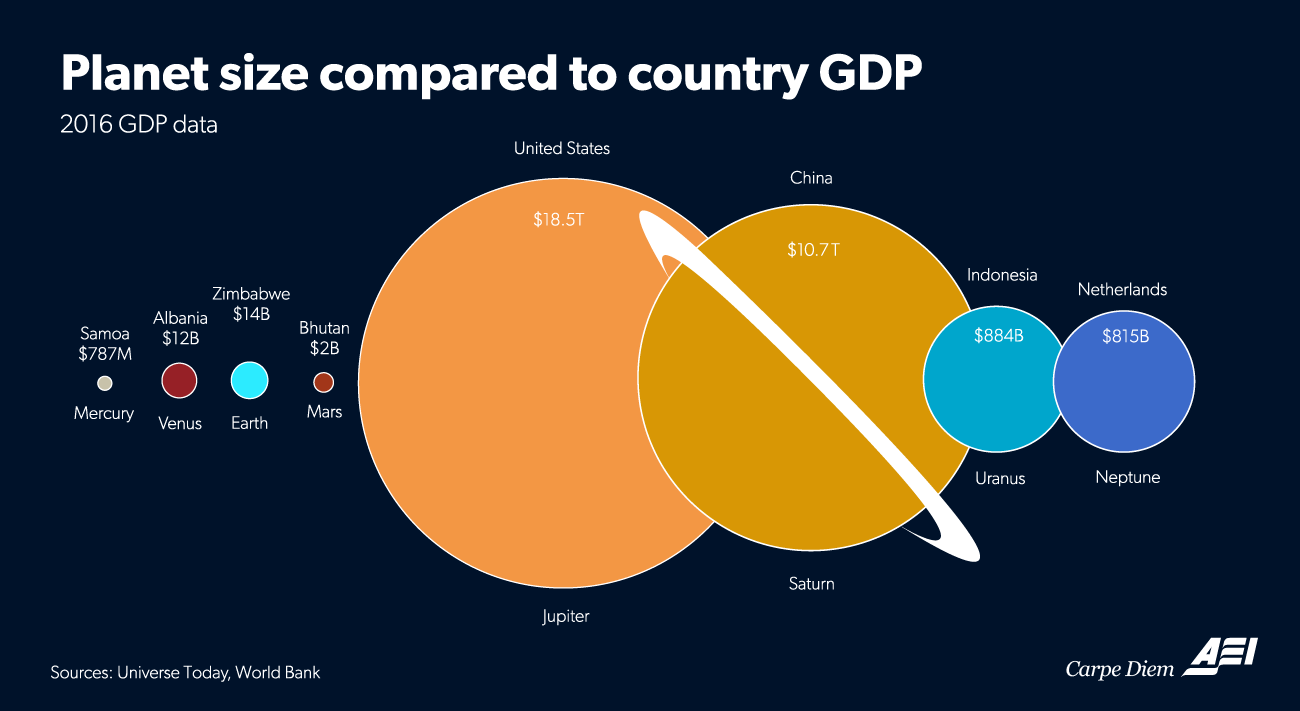
I used to have a facebook group where I'd take the AEI posts and dissect them. They'd do something like have two circles representing values, but the values are actually the radius of the circles ... so they are off by 3.14*r^2 in representation of the differences.
There were many other things where they would do something like float some chart so the bottom value is only 5% less than the top, and then zoom in so it covers a very small time period, and then purport it as being significant.
Literally every day. It was amazing. I went there right now, second post, comparing planets to GDP (http://9ol.es/planet.png) using inaccurate metrics of planet size and inaccurate calculations with relative mass along with depicting 3d objects as 2d... it's wildly inaccurate.
The issue is states trending towards the "mythical" free market have a track record of prosperity, while states tending towards mythical communism have a disastrous and bloody track record.
East and West Germany, North and South Korea, Maoist Guangzhou and Unregulated Hong Kong. Time and time again it has been shown that a large collectivist state does not deliver on any of its promises, but instead creates poverty and misery.
Now social democratic states can be relatively effective with a smaller population, and when administered by efficient, civic minded and hard-working people. The US Federal Government does not qualify.
The poster above was discussing attitudes towards government in Canada, it seems a bit of a non-sequitur to bring up East Germany, North Korea, and Maoist China. This is one of the very strange dichotomies which seems to exist in the US, as if when considering economics or government there are only two sides of the coin, and anything even vaguely centre left is on the same side as Communism.
What didibus said applies to almost every developed country in the world, there are definitely those ideas towards government in Germany (including West Germany before reunification), Japan, and the UK. In most developed countries, you would be hard-pushed to find any party which followed attitudes you might describe as 'starve the beast', 'the best government is the least government' and so on. Even the most conservative parties in those countries in general do not think like that.
Here's the crux of it - most developed countries in the world are poorer than the US. I'm in NZ, often held up as some kind of social democratic Utopia by progressive Americans. Salaries are lower, housing is unaffordable in places that are in no way comparable to San Francisco or New York, and goods are extremely expensive due to sky high import and sales taxes.
Well sure, but changing the economic system won't modify the fact that it's an island of 4 million people that's so far out on the periphery that it isn't even included on some world maps (https://www.reddit.com/r/MapsWithoutNZ/). The same economic realities can be said about Hawaii.
It's two major islands, closer to 5 million people, and we have a sales tax ("goods and services" or GST) of 15% that applies to everything, even groceries or imported electronics. This of course largely hits the working class. The rich don't rely on getting income from generating real value here - income tax is far too high. The key to becoming wealthy is to invest in property and rent it out at exorbitant prices to working class people.
Sorry, didn't know it was two islands ... shows my ignorance. I really don't know of New Zealands' economic structure. The argument I was trying to put forth is that there's a broader context that has exogenous influence upon any society and by extension, its economy.
I could have a broader discussion on taxation if you want, but I find it's important to establish, and agree, upon a number of facts before those can start being productive. It's a long haul conversation.
Most of the US's extra growth relative to those countries is down to increasing population. You can look back 50 years and you won't find much difference in terms of growth if you control for number of people:
By the end of that time period the US had become a much more powerful country, but the average person was not significantly more wealthy compared to those in other developed countries than they were at the start. Which would lead me to think the difference is mostly down to other factors - for instance natural resources, mining, timber, agriculture etc and also cheap plentiful land for house-building, the only industrial nation left standing after WWII, etc.
Part of the problem is that we keep electing people that want to destroy government instead of people that want to make government work better.
> East and West Germany
In your analysis does West Germany qualify as an example of glorious free market or as a social democratic state that is too small to serve as a good example?
That analysis ignores imperialism, transnational capitalism, colonialism, different signifiers of progress, and cherry-picks evidence from random points of history without doing any type of rigorous analysis.
It ignores the vast majority of history with no functional government, no taxes, and free markets such as say, 3000BC in Moscow --- take your pick. Was there technological advancements, well maintained cities, and a prosperous middle class of entrepreneurs and innovators in societies free of coercion? Where were the emergent social orders which arose as an inherent stochastic process from individual capital pursuit in say, 600AD in Berlin?
These only started happening after the rise of civic society and only in places with well-organized, democratically run institutions.
These apologists also choose to ignore any counter evidence.
There's over twice as many doctors per 1,000 people in Cuba than the US, however those facts are dismissed.
When people talk about how decrease in things like open sewage, food-borne disease and other civic advancements lead to increase in longevity, those facts are dismissed.
When people talk about how there's more affordability and more equitable medical care under democratically administered health systems, those facts are dismissed.
When people talk about what Nestle has done to privatized water, what the diamond industry has done to Africa, how the market-based oil system has kept the middle east in 21st century monarchies, those facts are dismissed.
Such claims as miraculous progress due to privatization are absurdist fantasies and easily refuted without even having to bring up their abysmal failures such as Puerto Rico, Enron, Pinochet's Chile.
It's dishonest to accuse me of cherry picking statistics - particularly when I never claimed my short post was a rigorous statistical analysis - then reply to me with your own cherry picked statistics. Nevertheless...
There's over twice as many doctors per 1,000 people in Cuba than the US, however those facts are dismissed.
And how does this effect the quality of life in Cuba? Life expectancy is the same [0]. Are working class Americans creating makeshift boats to sail to Cuba in order to benefit from the superior conditions?
When people talk about how decrease in things like open sewage, food-borne disease and other civic advancements lead to increase in longevity, those facts are dismissed.
Those are good things. Low tax, high income places tend to have these features as well, strangely enough. I recommend visiting Hong Kong or Singapore.
When people talk about how there's more affordability and more equitable medical care under democratically administered health systems, those facts are dismissed.
Those aren't facts. Those are vague hand waves.
When people talk about what Nestle has done to privatized water, what the diamond industry has done to Africa, how the market-based oil system has kept the middle east in 21st century monarchies, those facts are dismissed.
I never claimed markets were always benevolent. Simply that they tend towards more prosperity than collectivism. Also none of what you pointed to is particularly free of state involvement - states are all complicit.
You can "cherry pick" the worst examples of what corporations have done all you like, they pale into comparison to the cherry pickings of the worst thing public institutions like states have done (famines, genocides, world wars).
Such claims as miraculous progress due to privatization are absurdist fantasies and easily refuted.
It's not arguing in good faith to imply that the only reason I disagree with you is because my view point constitutes a religion, or because I simply haven't come to a certain point of enlightenment that you yourself have presumably reached.
Look, my position is simply anti-absolutism. I don't know what will be best suited for a problem before I understand the problem. The free market isn't always best, nor is any other system. I'm not against markets - I'm against it being the square peg for all the round holes of society. If it's a square hole, then go ahead, be my guest.
I'm anti-capitalist, anti-communist, anti-statist, anti-socialist ... anything with an "ist" - these are tools to solve different kinds of problems. We need to acknowledge their applications and limitations.
As an American myself, I've always wondered whether there was something in the culture/genes of Americans that predisposed people towards paranoia towards all forms of external authority.
I mean, American immigrants are literally a self-selected population of people who found their home societies chafing and restrictive enough that they were willing to migrate thousands of miles at great risk to build a new life. And this migration was repeated time and again within the US -- as each part of the country was populated, waves of Americans decided to strike out West and get out from underneath the bankers, politicians, and other elites that would take over.
I think paranoia about government will always be the flip side to wanting to be fully free and independent (whether or not that is achievable in reality).
I would submit that the difference you describe is partly because the US is so much bigger that each person has proportionally less control, and partly because Quebec is more socially cohesive than the US. The state of Oregon has a similar pro-government, pro-social welfare mentality. In their case, it's for kind of a dark reason; Oregon's historical racism makes for a more socially cohesive polity[1]. But in Quebec's case I think it's just a sense that other Québécois are family, and so services that only benefit other people still benefit everyone.
Well, I am, here and in my offline life. I like taxes, with them I buy civilization.
I'd happily spring for a slightly more up-market model of civilization, too, so I'm one of those pretty-well-off tech guys who advocates for higher taxes on me and people like me.
That is pretty tiny. Since the ACA has gone into effect, my family's health insurance has gone up $700 per MONTH ($500 of that just this year)! Nobody is voting that for themselves. But everyone wants world class health care, and we're compassionate and want everyone else to have it too - as long as we're not the ones paying. Well, I'm paying and it kind of sucks.
Yeah, returns from bus feeding commuter rail will be limited, need grade separated mass transit, or at the very least Bus Rapid Transit with dedicated lanes.
I'm willing to bet that most people who "want someone else to pay for services" mean "corporations" and "super-rich people", both of which get away with not paying nearly as much as we're told they should.
I am glad to pay taxes in exchange for public goods/services like roads, schools, libraries, ...
...bombs, bailouts, bribes, bureaucratic inefficiency, lining the pockets of lobby groups, incarceration for victimless crimes, keeping cops charged with police brutality on the payroll...
I would encourage you to check the officially published breakdown of how taxes are spent - and then consider what the actual break down might look like.
People have a real cognitive dissonance when it comes to the state. I think it's hard for people to deal with the the fact that money will inevitably be taken from you under threat of force to fund things you hate, that you find wrong, or that ruins peoples lives. It's much easier to just close your eyes and think of roads, schools and libraries.
Government jobs (and contractor jobs) are stable, pay well even for people who don't have great educational backgrounds, and companies like Lockheed know how to spread around defense dollars so it becomes a jobs program in all 50 states.
In this sense, the inefficiency is a feature, not a bug.
I'm glad to pay my fair share too (I don't look for every single deduction I can possibly find). However, it doesn't mean I want to pay any more than what I'm paying now. There is a definite limit.
Not true! I'm happy to pay higher taxes. They passed a yearly art fund tax here.
People bitched, I said "quiet you +$100k yr coworkers who moved here recently after hearing how rad it is! It's rad because of these things!"
I'm happy to piss an the parade of anyone who complains about paying taxes. Especially those that benefit disproportionately, like tech workers (high tech being subsidized by the government since the industrial revolution came along).
I don't want someone else to pay for it but I want them to contribute.