And even with an ordinary socket, mITX boards have anemic amounts of PCIe lanes. One of the top selling points of TR is the huge number of PCIe lanes for a non-server part. All ATX boards around launch were required to support the full complement of physical lanes. A mITX configuration would have both anemic PCIe and anemic memory.
Yeah, 4 DIMMs should be sufficient[0], and I guess some mini-ITX boards have 4 slots (e.g., ASRock X299E-ITX/ac).
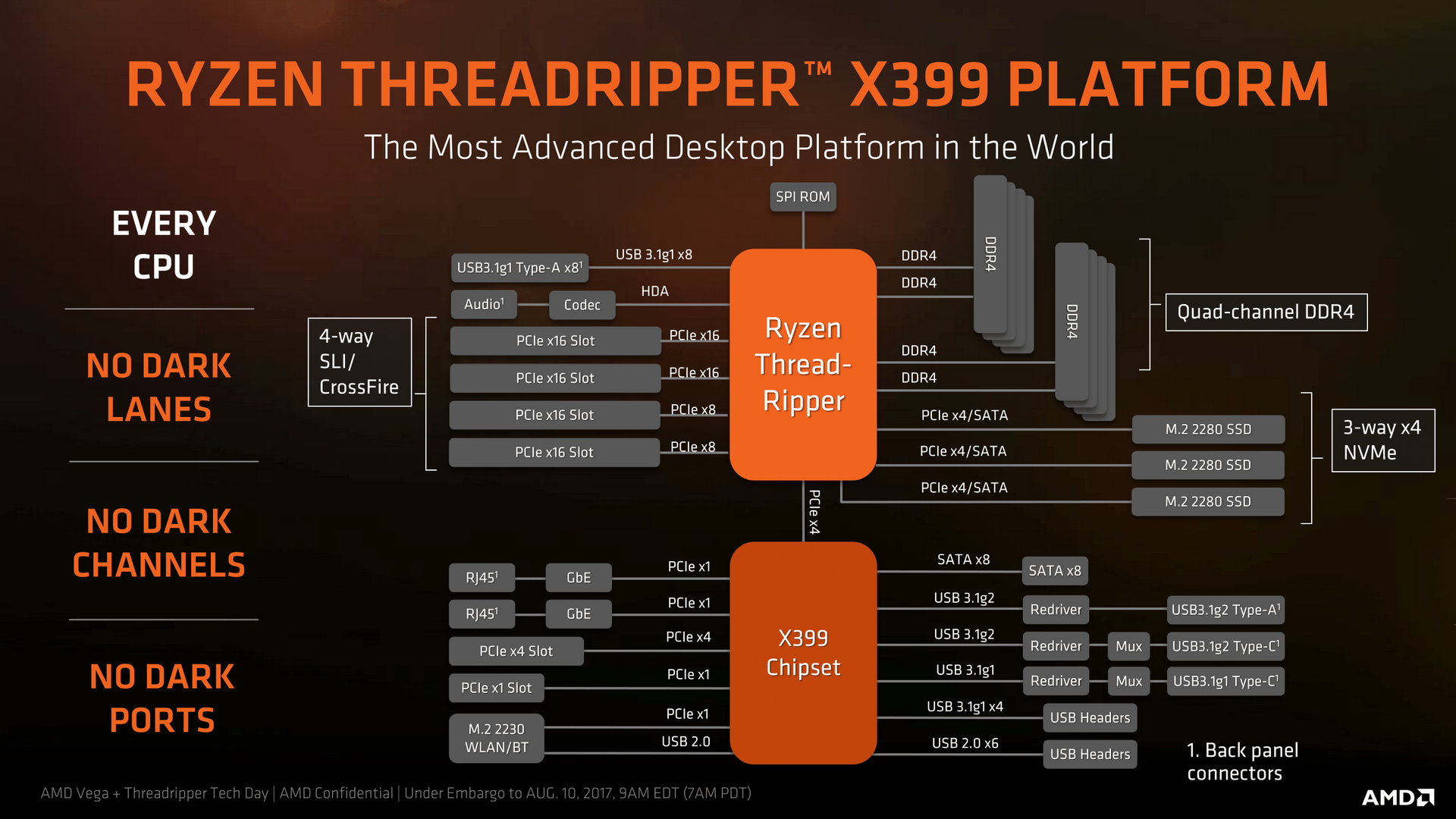
I don't know about TR working without a chipset. This picture[1] suggests the X399 part isn't absolutely essential, but I don't know if there are other considerations that make it essential.
Anandtech says[2]:
> Unlike Ryzen, the base processor is not a true SoC as the term has evolved over the years. In order to get the compliment of SATA and USB ports, each Threadripper CPU needs to be paired with an X399 chipset. So aside from the CPU PCIe lanes, the 'new' X399 chipset also gets some IO to play with.
So, maybe? If you are willing to forgo all the chipset-attached IO, and most PCIe lanes. That could be useful for a niche workflow or maybe a small form-factor desktop workstation that just needs CPU compute.