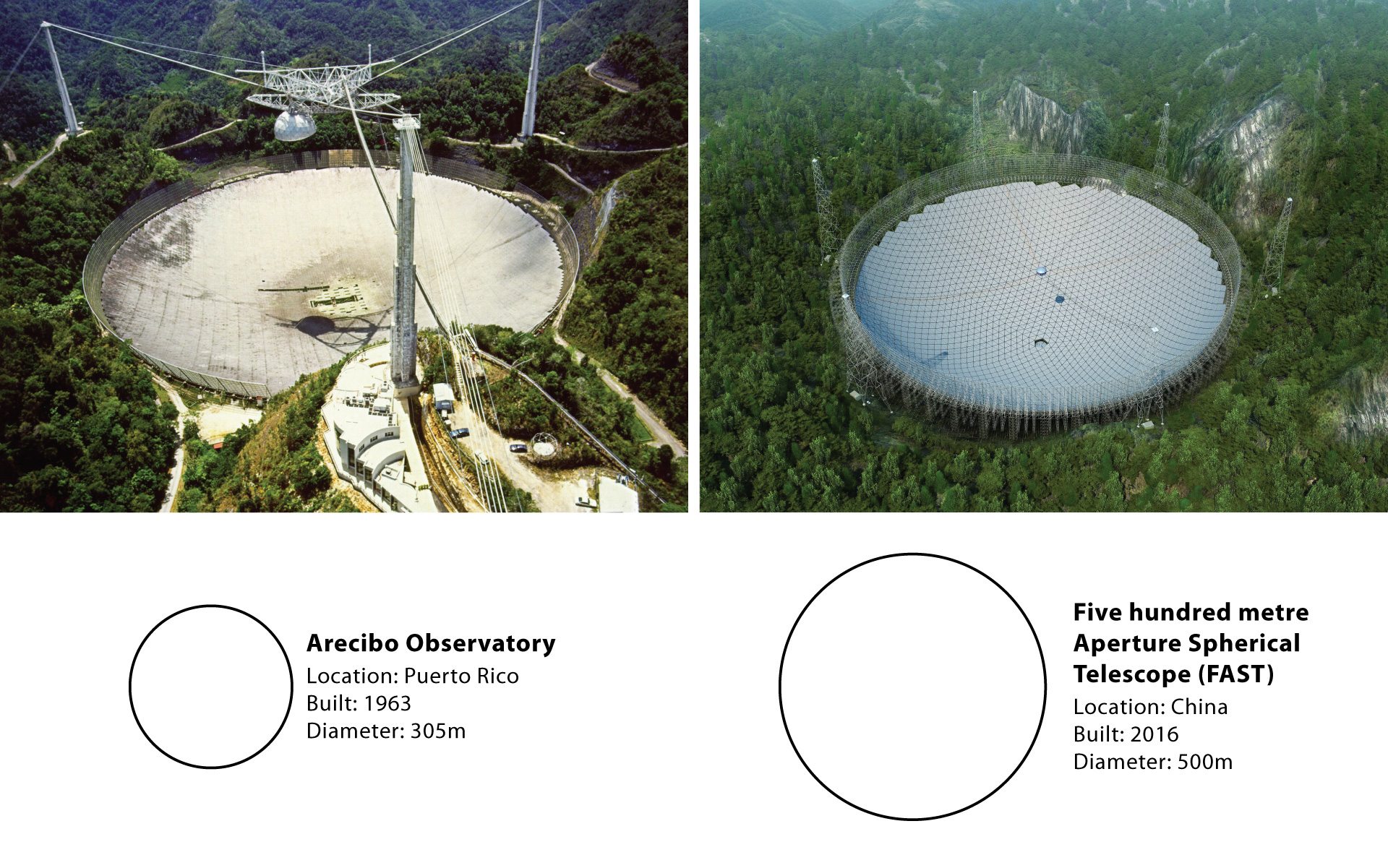
The gantry moves around on the cables held by the pylons on the edges. If it were a transmitter, the beam of radio waves would shoot out in a different direction based on what part of the surface it was illuminating. However, the really clever thing about FAST is that the surface is not just a passive metal net like Arecibo, but an active surface of triangular panels. The panels reform the normally spherical surface into a parabola. So you can imagine the surface deforming as the gantry shuttles overhead to make the correct optical surface. This is pretty hard to do right, so most observations so far have been setting the surface to look straight up and leaving the gantry in place, observing a stripe as the sky passes overhead.
Just for comparison: FAST has a diameter of 500m, wavelength 0.10 cm. Arecibo diameter 305m, wavelength 3 cm. Focal lengths are comparable; FAST has nearly 3 times the collecting area.
One advantage is that it is much easier to create multi-pixel receiver systems. Having two receivers at the focus is like having two telescopes! So for survey science, it is much more economical than building 50 telescopes with a total equivalent area and one receiver each than building one telescope and 50 receivers.
However the main reasons we often don't build big single dishes is that (1) it's very hard to keep the surfaces from deforming from gravity and heat (the GBT for example needs to be accurate to 0.2mm over two acres of surface), and (2) the bigger the telescope gets the bigger the sail with respect to the wind, which makes it hard to point and keep the pointing accurate.
Just much larger actual signal collection area — means higher SNR and weaker signals can be detected. Don’t have to worry about complicated interferometry.
I think the interference that is caused by visitors to the theme park is limited, since the cell phone / WiFi bandwidths are around 800 MHz to 5 GHz and the operating range of the telescope is 70 MHz to (max) 3 GHz. I think the focus of most research will be in the lower part of that spectral range, i.e. the frequencies that are not emitted by consumer devices.
Edit: the directivity of such a large telescope is also big. Around 45 dBi at the lowest frequency (70 MHz). That means the telescope is not very sensitive to radiation from sources near the horizon and more sensitive to radiation coming from it's pointing direction (closer to zenith).
Unfortunately this is not the case for a few reasons. The radio observatories in the US with visitor centers nearby have substantial problems with RFI among visitors. The receivers are extremely sensitive, shoddy electronics often emit outside their regulated spectrum, and the signal can be contaminated after it's been converted from the sky frequency to an intermediate frequency inside the electronics (often around 1 GHz) despite shielding. At Kitt Peak, observations with the VLBA station during the day are often nuked (esp. 2 GHz, "S Band"), and at the VLA many large programs aren't even scheduled when there will be many visitors. However this is known and acceptable because visitors are the lifeblood of the facility! It's a bit of a catch-22, because it means the facility is less functional, but it shows citizens why they should support the facility with their tax dollars and also support science in general.
For FAST, one must understand that this could not be smaller potatoes for the PRC, as big as it is. A hundred million dollars for a government project is a rounding error. However, the excellence of the design and it being the best in the world on some metrics has engaged the Chinese public in a huge way. Consider how popular space is with the public in the US and Europe, and that the PRC has not really had a world leading facility (Hubble, Keck/VLT, VLA, ALMA, etc.) to engage that latent interest. I have heard an anecdote from an astronomer that they have gotten so much bang for their bunk in this way, that the government may simply build a second one and keep the first for tourists!