It was the 80s. My parent bought a Tandy 1000 SX for their business. It worked fine for a while, until one day it started randomly crashing, and occasionally showing a little dot bouncing around the screen.
They took that thing to countless computer stores to have it fixed. Nobody could figure it out. Everybody said it was working just fine.
My dad got so fed up he bought a new computer and told me that if I could fix it, I could keep it.
And of course I figured it out! Turns out, it was infected with the Ping Pong [1] virus. One of the very first viruses. Certainly the first I had ever witnessed, or anybody I knew for that matter. That day, John McAfee got me a free computer!
It’s been a while so I don’t remember. I was like 8 or 9 years old.
I’m assuming someone somewhere told me about viruses and gave me a copy of McAfee.
I remember when it all clicked though. All our computers started acting the same with the ping pong ball. The virus was spreading whenever I was inserting a floppy in an infected machine. I had a ton of floppies to clean.
Download the shareware version of McAfee ViruScan from a BBS, I imagine, and then maybe buy a virus cleaner? Or, more likely, make an illegal copy of one.
Little piece of Tandy errata: They had their own subway line in downtown Fort Worth[1]. It was there before they built their headquarters, The Tandy Center, but they kept it running and it terminated in a parking lot that also had a little farmers market that my family used to sell watermelons at when I was a kid in the early 90s. If we sold all of the melons early we would take the train into the Tandy Center for the fun of it.
This sort of glosses over all the other computers Tandy made or rebadged. It only briefly refers to the original TRS-80s, and doesn't seem to mention anything else like the CoCos, the Pocket Computers and the Model 100 family. At least for a period of time those were nearly as important as the PCs, particularly the M100. I worked with an elementary school teacher who had a whole room full of networked CoCo 2s (using the cassette interface rotary network) and a CoCo 3 as the server. The fractions math trainer I wrote for them was still in use years later.
Tandy models 2, 12, 16 and 6000 were great business machines: they had 80x24 screen, buffered keyboard (just like IBM PC), and had lots of software support (Xenix, TRSDOS, CP/M, RM/COS).
IBM PC was basically the same thing, but cheaper and had even higher quality keyboards and screens.
CoCo had a nice CPU, but otherwise was junk. I bought a CoCo3 recently, and have been playing with OS-9. If only there had been a popular 6809-based computer with better hardware than the CoCo.
> If only there had been a popular 6809-based computer with better hardware than the CoCo.
That wasn't really the issue, the C64 wasn't much better yet became the best selling computer of all time.
At Tandy, the owner died right in the late 70s. And then, I seem to recall that Tandy had not one but two embezzlement scandals at points when the company needed to have vision because the underlying business economics were shifting.
>> If only there had been a popular 6809-based computer with better hardware than the CoCo.
> That wasn't really the issue, the C64 wasn't much better
the 6809 was a really nice "ultimate" evolution of the 8-bit CPU. The C-64 was just another primitive 6502. So I think GP meant "I wish there was a 6809 I could get that wasn't the CoCo, because I want a 6809!" rather than meaning that the hardware doomed the CoCo or something.
In a way it did. Tandy offloaded every possible function onto the processor to lower part count and hence cost, resulting in the infamous bit banger serial port and the equally infamous high resolution mouse adapter, which made the CPU time the discharge of a capacitor to figure out where the mouse pointer was, so you learned quickly to keep the mouse at the top left, minimizing that time, unless absolutely necessary. DMA for disk I/O? Only with third party hardware.
My first computer was a TRS-80 Color Computer. My second computer was a Commodore 64.
Other than the CPU, the Commodore 64 was better in every way. Graphics, lowercase, SID for sound, real interrupts for data, keyboard... so many other reasons.
The Commodore 64 was better than the TRS-80 Color Computer. Much better.
I was remembering the VIC-20 which was the contemporary of the TRS-80.
Yes, the C64 was quite a bit better. But it came out roughly 2-3 years later, and was triple the price of a CoCo2 until the first round of price cuts (at which point it was still double).
My junior high school library had Tandy Model IIIs that I learned to program on (alongside the Apple IIs). The elementary school had a mix of CoCo 2s and Apples.
My first computer was a TRS-80 CoCo2 because it was the one I used in elementary school. (You must be at least 10 years older than me!) Loved that computer and still have it in a box in my garage. I've always been deeply insulted by anyone who called it a "trash 80". Usually they were the kids who had a Commodore 64, which admittedly was a better machine, but still!
The M100 never really seemed to find its niche with people. It was simply too expensive for what you got on top of not being able to play games on your color TV--both of which limited the mass appeal.
We had that same rotary network in school (1986). It was neat that you would download to multiple machines at once, then upload from individuals. Of course we'd play Telengard and Battlezone when not programming, or using the hex editor to put 4 letter words in Battlezone. Fun times. I have a Model 100 I need to dig out and play with. I'd still like to have a Model 3.
My family bought a Tandy 1000 around 1985. I was eight years old and quickly started writing batch scripts and rudimentary BASIC games. My friend had a Tandy too and, being a musician, talked all the time about their "three-voice sound." We taught ourselves BASIC together by decoding the spiral-bound reference manual that came with the computer. Without any tutorial-style material it was rough going, but we persisted. I remember him trying to explain for loops to me and I was just n-o-t getting it. And I always wondered what GOSUB was for. "Why would you want to go somewhere then just come back again?" After several years it finally clicked when I independently invented function calls. ;-)
Had similar experience with our Commodore 128 (even had a spiral-bound brick of a manual too). Between that and just the old LIST command, I was able to poke around in loads of games and programs and see how they worked (or, say, give myself a million gold in Telengard).
I did grasp GOSUB fairly easily but I never understood why I could load some programs from disk, but when I typed LIST, I would just see a single line with SYS (and a number). Didn't realize until later that this was just a way to call machine language code that had been loaded directly into memory.
I think I stumbled across this, but I was in grade school and without another spiral-bound reference to make sense of it, it just looked like gibberish to me. I was still a little way off from learning the benefits of "structured programming" for easier debugging and tweaking, so long piles of BASIC was my limit at the time.
I remember that spiral bound reference manual. Learning from that was like learning English by reading the dictionary. Thank goodness there were examples. I also never understood the point of GOSUB for a long time.
In middle school I had a friend with a Tandy 1000EX. I had an Amiga 500. He refused to believe the Amiga was a superior platform! Early 90's computer wars were so childish.
“ the reason there’s about a 90% chance you are reading this on a PC with an Intel or Intel compatible processor”
Here I am, reading this on a phone with an ARM-based CPU :) and some quick market share stats I found actually point to about 50% web traffic happening on mobile devices. So not 90%, no :)
My dad had a Tandy 1400LT - no hard drive, just whatever disk was inserted - I played Space Quest 2&3 and Leisure Suit Larry (I wouldn't let my own kids play that one at that age, but I honestly had no idea). I was upset it wouldn't play Space Quest 4. This triggered a latent memory of my first experience programming BASIC on it, putting me at 8-9 years old. I wish there was a laptop that difficult to use and durable today - my own kids ended up busting a raspberry pi 400 I got for them to mess around on.
Tandy 3000 is where it all started for me. My fam got it late in about 95.. A hand me down from my dad's friend.
We had a vic(?) in 92/93 but I don't recall my dad ever doing anything with it and I only ever got a simple sample program running from the huge manual. After much trial and frustration; was 7-8.
So Tandy. DOS, a commander like compressed launcher... Everything had to explode before it ran haha. Loaded with stealth fighter and some other games. Monitor had to be banged to get the colors right every so often.
Sierra games. Ran up huge help line bill. Father was PO'd; we didn't have a lot of means haha.
486 came with second marriage. Got video game programming in 21!days box bundle from Sam's publishing for Xmas. Nothing worked properly on windows 3.1 ootb back then. Really turned me off programming for a long time.
The neighbors had a Tandy 1000. One of the lower models, I don't remember which one. It didn't have a hard drive, only had 384KB of memory (not sure, it didn't have 640k so it wouldn't run some DOS games I brought over), but it did have a 720kb 3.5" disk drive (which couldn't read my 1.44MB disks)
We mostly played around with Deskmate and GWBASIC, but my friends mother was taking computer science classes and gave me a floppy with Turbo Pascal 2.0 on it. That was a big deal.
I had a 386SX at home which was pretty low end, but this computer was quite a bit older than that, but she did buy it new. I remember the guy from the store coming over there to set it up, I want to say they paid $599 for it.
That's an oddity; there was no Tandy 1000 model that came with 384 KB RAM and a 3.5" drive. The SX and SL had that amount of RAM but a 5.25" drive. The TX and TL had a 3.5" drive but 640 KB RAM.
Was DeskMate in ROM? That would narrow it down to an SL or TL.
Tandy 1000 Ex/HX had 256k… adding the MemoryPlus DMA upgrade board got you to 384k. The HX had a 3.5” drive and DOS in rom. I remember impressing my friends by booting to cmd without a floppy inserted. “Wow you have a hard drive?” Lol no.
We didn't have much money, so until 1997 my home computer was a 1000 hx. dos 2.11 in rom, but you had to boot 3.2 from a floppy to run a lot of "newer" software.
the memory upgrade card got you to 384, then you could buy a tube of ICs to fill out the rest of the dip sockets on the memory card for a beastly 640k
ROM, and like I said so t remember the exact amount of RAM, I just know it wasn't 640k. And it only had a single 3.5", no 5.25" drive. I had both drives in my 386 so tradings software disks was always tricky.
The Tandy 1000 SL/2 had DOS and DeskMate in ROM, a single 3.5" 720K floppy, and shipped with only 512KB of RAM, which wasn't enough for some games. You could upgrade it to 640KB though.
If they're misremembering the RAM size, could be the RL. I had one, and I recall it came with 512KB RAM expandable to 768KB via installing a couple DIPs into sockets.
Old reply but you're talking about my childhood so I'll do it anyway :)
The 1000RL definitely did not come with a hard drive by default. I added a 20MB hard drive to mine a year or so after my family bought it. 3.5" 720KB floppy was the only built in storage.
Ah yes, Turbo Pascal 2.0! My brother and I got it as a shared birthday gift. We spent a lot of time trying to understand what happened to GOTO, which we had used a lot when programming with GWBASIC.
My father and I purchased all our consumer electronics at Radio Shack back in the day. I had a full line of gadgets: microcassette recorders, RC vehicles, a 2" battery handheld LCD TV, cables, batteries, you name it. The clerk at the mall, Jon, was like my best friend; we had long meandering conversations. Hopefully they were mostly about electronics, I guess. Of course he knew how to sell me the good stuff!
However, my family never owned a single Tandy system. First we picked up an Atari VCS, and it stayed at Grandma's, because Mom was afraid we'd mess up the color TV. For reasons I cannot recall, we became a Commodore family with the purchase of a VIC-20 for my exclusive use, hooked up to the very living-room TV that was precious to Mom and Dad.
I hardly had any contact with Tandy computers, other than the one on display at Radio Shack. School computers were TI-99/4a, then there were C64s at high school; the family friend owned an Apple ][e, my girlfriend in the mid-90s was an Amiga girl, and I just never had occasion to lay hands on a Tandy. Oh well!
Radio Shack may have been selling IBMs by 1995, but by 1998, they were in a big partnership with Compaq instead. I worked at one then while in college and earned great commissions on them; they were the big ticket. The Radio Shack strategy at that time was shifting towards licensing big name products such as Compaq, Sprint PCS mobile phones, and Sprint cordless landline phones. They even had Scotty from Star Trek promoting a battery club!
My first computer was an Tandy 1000EX (in... 1986?), and this article is spot-on. The sound and graphics were miles ahead of my friends with IBM and Apple PCs at home (but not quite as good as the Commodores). And, as the article points out, they didn't keep up with standards. I made the mistake of going with nostalgia and "upgrading" to a Tandy 1000TX in 1992 when I headed off to college, and everyone else was running Windows (my old Tandy could run Windows 3.0, but not 3.1). I ended up needing to do my homework on my roommate's Wang (another dinosaur) PC.
Still nostalgic for my first Tandy 1000, but I regretted my decision to get the second one, and ultimately sold it a year later to buy a no-name 486 PC.
My parents had a Tandy when I was young, so from about '90-'96 (we got a Windows 95 desktop around that time). I distinctly remember my first video game, Donald's Alphabet Chase (starring Donald Duck) but didn't discover until years later that it was developed by Westwood, of Command and Conquer fame.
We also had a typewriter as our printer, which had a single line preview/edit mode when using as a typewriter, and a daisywheel printer sort of mechanism when printing from the PC.
This was my first computer too! But I didn't get my until '95 (I was 12) as a hand-me-down from an uncle. It's the computer that I learned how to learn on. I learned DOS by myself from a DOS For Dummies book which let me figure out how to install and play games on the computer. I also picked up Basic which started my adventures in computer programming. This single opportunity set me down the path of learning and making a living from technology for the rest of my life. I've no idea what I would be doing today if I never received that computer.
I'm not old enough to have grown up on Tandy computers(though I recall my parents having what may have been a CoCo when I was very young), I do have have a 1000TX and CoCo 2 as part of my retro computer collection. I really kind of like that 1000TX in my collection. Not only is it one of my favorite XT compatibles(technically it has a 286, but still effectively has an XT rather AT architecture, so it ends up basically being a fast 8088) in my collection, that Tandy graphics and sound also give a bit of a soul of an 8-bit home computer and was pretty well supported by games of the era, especially compared other niche graphics and sound technologies.
I feel like this story crossed into Halt and Catch Fire a few times.
A friend of mine had one of these machines in the early 90's as a hand-me-down. It was his own computer! Unheard of at the time for me and most families I knew that had a computer. They were shared!
My first computer was a Tandy 1000HX. Without it I would probably never have gotten into the career I have now. Nothing but fond memories of that thing.
I could have posted this comment verbatim! (Except mine was a TX.) I was poor growing up and couldn't afford a computer and it changed everything when I got the Tandy. My mother was a hairdresser. She got to talking to one of her clients about me and, long story short, her client gave me the Tandy along with a bunch of manuals and programming books. She also came to our apartment and got me started on it. Even showed me the internals. I owe a great deal to that woman!
Ditto but mine was a TL with TWO 1.44MB floppy drives that I later crammed a massive 10MB hard drive into and dangled a 300 baud external modem off of!
IIRC that thing was like $1500 in 1987 dollars. I have no idea at all how my parents could afford it but I'm sure glad they did. Every single dollar I've earned as an adult was because of that purchase.
Same, but mine was a Tandy 1000 SL/2. Taught myself DOS, BASIC, Turbo Pascal, some Assembler.
Got a 1200bps modem and discovered BBSes, got a wardialer, discovered an unsecured university dial-in and started learning the internet. There were no commercial ISPs back then and no web. It was all text-mode: gopher, archie and veronica, usenet, ftp. Finding text files of the old 2600 and Phreak magazines and the Anarchist's Cookbook felt so cool. Then I found MUDs and IRC.
The T1000 could play all the hot games at the time, flight sims, Sierra adventure games, etc., with better graphics and sound than other computers. But there was just something special about playing a text-mode MUD with hundreds of other people from all over the world.
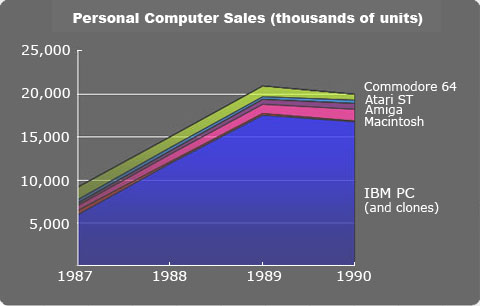
Everything got crushed by the IBM PC, including IBM. Largely because it was open (enough) and could be reverse engineered.
Apple is the only other notable survivor of the era, by its fingernails and $150 million from Microsoft in the late 90s to give the appearance of competition and appease regulators. Arstechnica has a great piece on this:
Specifically these graphs. By 1990 it was all over in PCs. Unix workstations held on for another decade until Linux on Intel dealt them a deathblow, aka Coup de Grâce.
Of course, most of these companies made bad decisions that led to their downfall. Which TFA details. But the super-competitive environment made bad decisions fatal rather than recoverable.
Apple survived because Amelio had gotten financial controls in place and Steve Jobs was able to convince bankers that Apple had a future. The $150 million from MS was for show.
I knew one of the Tandy children. He lived in the Virgin Islands and was known as “the water mon.” He sold 5 gallon bottles of water out of a white van. It would be hard to guess that he was from money and had money.
I remember the brand, though I never came near one. Friends all had various other machines.
Sounds like they missed the memo about Moore's Law. It really was a special time for home computing in the 1990s, every time I went to see a friend with a new machine it would be miles better than one from just a few months earlier. Sounds went from a bunch of beeps to what we now think of as ordinary. Graphics went from green text on a black screen to proper 3D. The father of a friend of mine had a high end machine that he used to do research, super precious about it. Not long after I had a gaming machine that was much better.
You can see why your average business manager might think to keep the outdated models around as entry level machines, and then people got so disappointed they never came back.
In the era before 3D graphics became the default for games, it was often the case that people would justify upgrading a machine in order to be able to handle spreadsheets better, but coincidentally it now also ran video games better as well.
I have no idea how many times business software served as a handy excuse for fun, but it was a lot.
> And I will argue the reason there’s about a 90% chance you are reading this on a PC with an Intel or Intel compatible processor in it has a lot to do with Tandy
Nope. The reason you are reading this on PC/intel is because of clone motherboards and CPUs which made home computers affordable and small-shops/hobbyists could build their own.
Name brands were twice the price, the Apple universe was four times the price.
I think both are true. The important thing with the Tandy 1000 is that it had decent graphics and sound and so was attractive to the home buyer who probably wanted to play games. These eventually made it to the cheap clone market via sound and graphics cards, but when the Tandy 1000 was released, IBM compatible PCs were seen as business machines and not really game machines. In the late 1980s you'd be better off with an Amiga or even an 8-bit machine if you wanted to play games than with most IBM compatible machines.
Selling an 8086 with 512KiB of RAM in 01992? Maybe this is another story about how nontechnical people fail to manage technical companies: maybe leathercrafting supplies merchant Charles Tandy didn't understand what it meant, in user experience terms, that their competition was shipping 32-bit 100MHz 80486es with 4 MiB of RAM. Maybe it didn't occur to him that things might have changed significantly in only a year. In some sense the network effects of the computer market meant that some platform consolidation was inevitable, and that was going to open up opportunities for manufacturing economies of scale the smaller players couldn't match.
Does something similar explain what happened to Datapoint? They were a great up-and-coming company until 01981, roughly the time that Commodore shipped the VIC-20 and IBM shipped the PC, and then they suddenly cratered. Did they die because they were still selling 8008-compatible machines with no graphics or sound, at a price only businesses would be interested in? Or was it that IBM had a better price and a better sales force for those businesses?
Charles Tandy was long dead by this point. I don’t know what happened at Radio Shack that caused them to drop the ball on the computer line in the late 80’s/early 90’s, but they sure did drop the ball.
> The problem was, Tandy didn’t really have a succession plan [for the Tandy 1000].
Sounds familiar... sitting back and treating their successful models as cash cows killed at least one other home computer pioneer: Commodore. The original Amigas (A1000/A500/A2000) were successful (more in Europe than in the US, but still), but they were never able to come up with a worthy successor until it was too late.
Living through that era, I recall that Linus Torvalds talked a lot of smack about the 80286. The 386 was just so much better for implementing Unix on that they didn't even want to deal with it.
So there seems to be this uncanny valley between 8086 and 386, where a lot of people either dragged their feet or jumped forward as soon as they could.
My transition to a 386 was very abrupt, facilitated by a Christmas present that could not run on an 8086 machine. But one of the first things I installed on it was Windows, and I went from "How will I ever fill up a 40MB hard drive?" to "oh wow it's almost half full already" in a matter of weeks. I suspect a lot of people were experience 'sticker shock' with respect to file size inflation as well, leading to more foot dragging.
I guess its the lack of a killer app for the 286? Was there much software for DOS that actually needed a 286 as a minimum? I get the impression they were often just used as "fast XTs".
Some of this is due to various limitations that make using the new features of the 286 in DOS a pain (or putting major DOS compatibility limitations on OS/2 1.x, which is probably partly why no-one used OS/2 at the time).
The 386 had features that were actually used like 32 bit support and a protected mode that could actually work alongside DOS. Plus its around this time you got Windows 3.x in 386 Enhanced Mode, which is around the point Windows actually becomes a thing people use. So you get a lot more apps that basically require a 386, rather than the generic mass of DOS software that runs on just about anything beforehand.
> Was there much software for DOS that actually needed a 286 as a minimum?
Unless you decided to run OS/2 or XENIX (which was really the big deal for the 286), the only advantage was you didn't need a special memory card to exceed 640k of memory with most DOS software - so maybe, roomier, faster XT... My first "real" computer was a 286 with 2MB of RAM... and I mostly used the upper 1MB as a RAM disk which made loading the next level on a lot of games much faster.
Bill Gates called the 286 "brain damaged". It had a protected mode, but you couldn't get out of it without doing a system reset. Even in protected mode it still had jankass segmented memory addressing because the register width wasn't actually wide enough to accommodate the 24-bit address space.
The i386 and later had 32-bit registers, 32-bit pointers, and could do flat addressing in protected mode. No more having to faff about with near and far pointers or segment descriptors.
I can fully understand Linus that he didn't want to adapt Linux to work on a 16 bit CPU. When he started with it, those were on their way out already, so it would have been pretty pointless...
I suspect it got assassinated from Intel with the 386SX. Killing the 286 got rid of most of the remaining second-source competitors, until the Am386 came in to save the day.
When there was a significant gap in pricing between a 286 and a 386DX, there was definitely a case for "you can put more memory or a faster disc in the 286, or just bring down the total bill, even if both are 16/20/25MHz parts." You could make a compelling argument for buying the 286 if you knew you weren't running 386-specific software.
Once the 386SX, with its lower price and ability to be easily adapted to existing 286 designs, hit the market, the case was much harder to argue.
My family's first PC was a 386SX/16 clone. We never ran anything that was 386-specific on it except maybe one or two games, never expanded past the soldered-on 1Mb. A 286 would probably have done just as well, but the general hive-mind opinion of the time was "be sure and get a 386" (along with "be sure and get both sizes floppy drive")
I grew up during that time. In the late 80's, early 90's teenage BBS world, 286's were considered lame. You could understand someone being stuck on a 8086/8088: they couldn't afford to upgrade. But for a few more bucks, you could get a 386SX instead of a 286 and do way cooler stuff.
The person at Commodore who didn't have a plan for the future of computing was Irving Gould. He didn't use computers and wanted to extract as much value as possible into his own bank account. His henchman who executed it was Mehdi Ali. They cut research and engineering to save money, ensuring anything in the labs would never make it to market in time to be competitive. They fired Thomas Rattigan, the man who got the Amiga 500 and Amiga 2000 projects going. The Amiga 500 sold more units than the other Amiga models combined and kept the company going long enough to release the A3000 and A1200/4000 before it bankrupted. The only person who got what they wanted was Irving Gould. He got to die with a few more millions in his bank account.
Tandy shipped more advanced, AT-class and 32-bit systems in its 3000/4000 line, but they were outcompeted by white- and gray-box clone makers in the business market.
I was at a newspaper in 1992 and we all used Tandy TRS-80 computers writing to huge floppy discs. Our finished copy would find its way to Compugraphic Unisetter machines for output.
Inside of a year I was at a place using Aldus Pagemaker on Macs to paginate.
I loved my Tandy. It's nice to see it in the front page of HN, but the shallow content and the thousands of ads in the middle of the article made it for a really depressing read.
My very first experience with a computer was playing Temple of Apshi on a TRS-80. My friend's father had it. This must have been early 80s. I remember him having to use a pencil eraser tip to turn it on. Thought that was odd. Shortly afterwards I started using the Apple II and II+ at school. Never saw another Tandy computer in the flesh. My friends all had Commodores and I eventually got a 128 myself after an abusive relationship with a Timex Sinclair 2068.
My second computer was an MC-10 bought on clearance. My route out and about on my bike usually took me to the local Radio Shack store where I'd spend an hour or two playing with the CoCo's, Tandys and such.
I currently have a Model 1 (part of my Holy Trinity) a 1000, an MC-10, a PC-1 and a CoCo 3... I really need to find another Model 100 (or 102)... had to sell the last one :(
Near as I can tell the only graphical game released for the Tandy 2000 was a special edition of Microsoft Flight Simulator that also supported the Tandy 1000 and 1200HD. The 2000 was in their business line, not quite PC compatible but it ran DOS and was supposed to run applications like MultiMate, dBASE, and Basic Four.
The Tandy 1000 line did support Sierra games very well.
> The Tandy 1000 line did support Sierra games very well.
Very true! I wonder if the Sierra games (e.g. King's Quest, Space Quest) were some of the "killer apps" for Tandy computers, i.e. the apps which made people want to buy a Tandy computer. Radio Shack certainly sold Sierra games and I always wanted the latest one for Christmas.
In the business world, things like spreadsheets were the killer apps, but I certainly didn't care about spreadsheets as a kid.
> Very true! I wonder if the Sierra games (e.g. King's Quest, Space Quest) were some of the "killer apps" for Tandy computers, i.e. the apps which made people want to buy a Tandy computer.
Before VGA and Sound Blaster came along, almost certainly. The Tandy 1000 line supported 3-voice sound and more colorful graphics in a manner almost identical to the PCjr, just in a less jank package. So they looked and sounded better on a Tandy than on most contemporary 80s PCs. Sierra games not only were sold at Radio Shack, but Tandy cross-promoted them in their store, even to the point of running special Sierra/Tandy demos on in-store machines to attract buyers.
My first PC was a Tandy1000RL. It was used and fairly obsolete by the time I got it, but I squeezed every drop I could get out of that thing. I learned DOS on it, and learned to reinstall DOS and deskmate after I accidentally blew away the OS with a misplaced deltree command. I spent quite a bit of time trying to make games in QBASIC.
I played a lot of old games on it, mostly purchased from corner stands in the super market and the occasional box title from Ames department store. They just sold the disk in a sleeve with a short description of what I was purchasing. I was constantly frustrated by my lack of VGA graphics, sound blaster and sometimes available conventional memory. Tandy graphics (which I learned later was really just a souped up version of CGA) were not that commonly supported so I was often stuck playing games in 4 color CGA mode. I eventually upgraded the RAM from 512KB to 768KB, which cost me $75!
The annoying double density 720K floppy drive was a non stop hassle requiring me to learn pkzip and zip spanning to split the contents of the then common high density disks on a school PC so I could then get the contents onto my hard drive. I had to go to my uncle's house if I wanted to get data off a 5.25" disks, and when he did the copies as a favor for me he usually returned a high density 3.5" that I still couldn't use directly.
I have no idea why I have such fond memories of that thing but I do.
back then I had a commodore vic 20 which ran out of ram simply coding up the creation of a backgammon game in basic so I borrowed a friends TRS80 ... wow what a dream machine ... I was able to finish writing the program and its graphics was infinitely higher resolution than my vic 20 ... I have fond memories of that Radio Shack box
It's well known that the Apple II was one of the first three prepackaged, preassembled personal computers on the market. It, the TRS-80 Model I, and the Commodore PET all appeared in late 1977.
It's not well known that the Apple was not the obvious winner of the three; the TRS-80 was. Every small town in America had Tandy's Radio Shack stores, and even if Radio Shack had a reputation for selling toys and gizmos as opposed to computers, it had a reputation. As a startup, Apple didn't. Commodore wasn't as well known as Tandy but was an established calculator and office-equipment company, with its own semiconductor fab that produced the 6502 CPU that Apple and other rivals used.
And, in fact, until about 1980, the TRS-80 dominated the market (as the article states). What happened?
* The disk drive. All three computers only used tape storage in 1977, but their makers soon provided disk drives. Tandy's drive is a horrible, unreliable kludge. Commodore's PET disk drives are gigantic monstrosities that are fast and reliable[1] but far too expensive. Steve Wozniak's Disk II is a combination of a brilliantly simple and reliable disk controller, and inexpensive-to-make (and thus highly profitable) drive mechanism, that still run well today, 40 years later.
* Third-party products. The TRS-80 came with a superb BASIC tutorial, but Tandy otherwise kept all software technical information secret,[2] hoping to monopolize third-party development.[3] Radio Shack stores were not allowed to sell non-Tandy products, and couldn't carry third-party publications like 80 Micro that by default became the major way companies sold TRS-80 products (since other retailers didn't want to compete with Radio Shack stores). Since corporate policy prevented Radio Shack clerks from admitting that third-party magazines or products existed (even while a Tandy executive wrote a regular column for 80 Micro, and the company regularly advertised in its pages), the only way a TRS-80 or Color Computer customer knew of this gigantic ecosystem's existence is if a friend told him, or he happened to walk by a newsstand with 80 Micro or Rainbow magazine.
Commodore's Jack Tramiel never ever understood the importance of software development, and the PET fell far behind Tandy and Apple in the US; until the VIC-20 in 1980 most of Commodore's computer sales were in Europe and Canada, where Apple and Tandy didn't compete.
Compare this to Apple, which published everything needed to create software and hardware for the II. Its slots invite engineers to design cards. A very important factor in the II's early popularity was school districts buying it to run educational software from MECC like Oregon Trail and Lemonade Stand. But this was not inevitable. A teacher or administrator in a rural school district in 1979 looking to purchase computers would naturally look to the Radio Shack in town, but would only have found incredibly crude Tandy-published software. Even with such handicaps Radio Shack had a substantial portion of the educational market, which after 1980 quickly eroded until 1985, when Tandy had an unexpected second computer boom driven by the PC-compatible Tandy 1000.
* VisiCalc. Because of the above, VisiCalc was written for the Apple when market share should have caused it to be written for TRS-80 (Dan Fylstra of Personal Software, VisiCalc's publisher, was one of the first owners of the TRS-80). Being only available for Apple massively drove sales of the II; for the first time, people bought a computer to run a specific killer app, as opposed to the other way around. In turn, others chose the II to develop for.
Even after 1980, when Apple had clearly gained sales momentum, Tandy still had the bulk of the installed base. 80 Micro's December 1982 issue <https://archive.org/details/80-microcomputing-magazine-1982-...> has 484 pages. I'm pretty sure no Apple magazine ever came close to that thickness; the only other computer magazines in history to be that thick are 1) PC Magazine before it went bimonthly in 1984 after the December 1983 issue hit 800 pages, and 2) BYTE. Wayne Green, the publisher of 80 Micro, had by that time written editorials in almost every single issue pleading with Tandy to encourage third-party developers. Tandy didn't relent until the Model 16, introduced that year, had zero third-party software after six months. But by then it was too late.
As fat as they are, reading Tandy magazines like 80 Micro and Rainbow <https://archive.org/details/rainbowmagazine-1983-12/> from the early 1980s is like visiting a sad and barren alternate world; instead of Origin, Sierra, MicroProse, and SSI, there are much cruder-looking ads from tiny companies offering bad clones of popular arcade games.
... And yet, despite its many, many mistakes, Tandy got a second chance with the Tandy 1000! As the article discusses, it was the best-selling low-cost PC compatible from 1985 onward. It was so popular that software boxes routinely stated that they were compatible with "IBM/Tandy". So popular that game developers routinely made sure that their products were "Tandy compatible"; that is, support Tandy's special graphics and sound features.[4] In the second half of the 1980s Tandy was arguably #2 in PC compatibles after Compaq, and clearly #1 among everyone, including IBM and Apple, in the home market. There was no reason whatsoever for Tandy and its gigantic distribution and retail network to lose out to Gateway and fellow Texan Dell ... But, of course, it did. So, yes, Tandy blew not one but two separate leads in the computer industry within a decade. That takes talent.
[1] Two virtues Commodore's later drives did not retain
[2] Read this BYTE article from two years after the TRS-80's release <https://archive.org/stream/byte-magazine-1979-08/1979_08_BYT...>, which a) discusses how to implement machine language graphics and b) complains about the complete lack of Tandy documentation that motivated the author to write the article in the first place.
[3] It's clear in retrospect that TRS-80 was intentionally designed to not be compatible with the existing 8080/Z80 standards. ROM's location in the memory map broke CP/M compatibility, and the expansion bus is not S-100 compatible.
[4] Actually PCjr-compatible, which the original Tandy 1000 was designed to clone


It was the 80s. My parent bought a Tandy 1000 SX for their business. It worked fine for a while, until one day it started randomly crashing, and occasionally showing a little dot bouncing around the screen.
They took that thing to countless computer stores to have it fixed. Nobody could figure it out. Everybody said it was working just fine.
My dad got so fed up he bought a new computer and told me that if I could fix it, I could keep it.
And of course I figured it out! Turns out, it was infected with the Ping Pong [1] virus. One of the very first viruses. Certainly the first I had ever witnessed, or anybody I knew for that matter. That day, John McAfee got me a free computer!
[1] https://en.wikipedia.org/wiki/Ping-Pong_virus