When I heard of this story, two fanciful case studies came to mind-
The Kingdom of Scotland attempts to build a colony in modern day Panama, goes bankrupt, looks to the English for support, leading to the creation of modern day Britain as well know it.
The Soviets being scared by Reagan's far out orbital SDI promises ("the Star Wars program"), causing them to overspend on defense and eventually go bust.
Not saying anything this drastic will necessarily happen to South Korea, but it's not the first time in history that a ridiculous boondoggle led to problems for an entire nation's finances.
>...causing them to overspend on defense and eventually go bust.
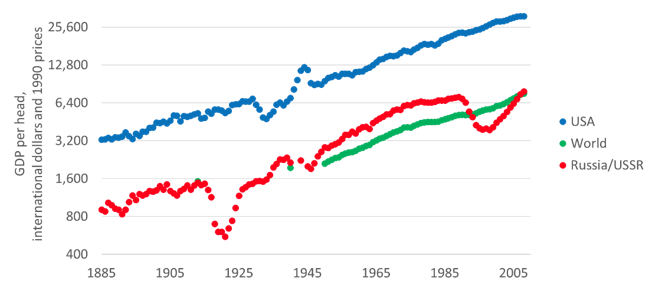
I heard this in school, but it felt like post-Cold war propaganda. Is this considered a true rendition of events? By all accounts, both sides just kept ramping up spending, it was just that Russia's line of credit ended sooner.
The US just outgrew the USSR and there's no single event that caused that. [0 - keep in mind that's a log scale]
It became untenable for a relatively small economy like the USSR to compete with the US, and Regan 'turning up the heat' may have had some impact, but it was likely negligable.
The Cold War was lost because Soviet-style economic management failed vs. US Style economic management.
What may have been a somewhat equal fight in 1950 was a joke by 1988.
No. Russia overspent because it was riding on an oil boom stemming from the oil crisis, instead of having to do reforms in the 70s. Then they got poor when oil prices came down and failed to reform fast enough to counter the new budgetary realities.
Yes people overthink it but it was essentially a resource economy boom-bust cycle situation, the belief that the good times will last forever is a hell of a drug.
It's mostly cold war propaganda, because the USSR was pouring an incredible amount of it's economic output into defense spending since WW2.
The star wars gap would have just meant that it couldn't maintain parity with the US on yet another battlefront, but nothing external was going to stop it from continuing on it's course. It would have had to reign in it's imperial ambitions some, but that is completely survivable for an industrialized nation.
What killed the USSR was Gorbachev prioritizing butter over guns, and having a shred of humanity in him, by choosing to not respond to political problems with violence. He was the real hero of the crisis, not for the things he did, but for the things he didn't do.
I don't think Star Wars by itself caused the Soviets to defense spend themselves into oblivion, but it was probably a high-profile example of Reagan saber-rattling that pushed them towards that direction.
It's one of those history is fantastical examples where an odd factoid is part of a greater trend. Like how American entry into World War I is partly because of the Zimmerman Telegram- the publicizing of German diplomatic efforts to entice Mexico into an invasion of the United States.
Wonder if Legoland Korea will end up as one of those factoids.
As Ukrainian, must say, Soviets, like ANY totalitarian system, once totally broke closed loop tie with reality, and build defense against fictional creatures.
This is what differs democracy, that it have powerful and reliable closed loop tie with reality, by definition.
> American entry into World War I is partly because of the Zimmerman Telegram
Do you really think, existed any tiny chance, US would not enter World War?
From geography, it is obvious, US is on the middle between EU and South America. In such position, you should become active subject, or you will be used by anybody as object, for just transit or as base for one side (borderland).
As example, Ukraine hundreds years was borderland, and this costs ocean of Ukrainian blood.
Prior to the sinking of the Lusitania, there was no guarantee that the fairly isolationist U.S. had any interest in getting entangled into Europe’s wars.
You know, Ukraine conducted policy of self isolation, before war.
Now running to EU and NATO, because isolation costs too much, concessions don't give security.
And for US, entanglement in world policy is matter of existence, because of how Union born.
If federal govt will not protect allies, federation will fall, because states will get out and do all themselves.
Imagine, Scottish, or Irish, or Italian people, ignoring what happen in their motherland - this is impossible. and if feds will entangle in ANY european activity, they will in short time have to deal with all most powerful currents.
South America different, because nearly all countries have mostly native people, or totally cosmopolitan, so for them european currents are just performance, nothing more.
The difference is that the U.S. is separated from Europe by an ocean, has no countries with revanchist claims upon it, has a New World vs. Old World distinction, etc…
> From geography, it is obvious, US is on the middle between EU and South America
It's super jarring to see a reference to the EU as a reason for pretty much anything WWI related. I know this presumably means Europe, and maybe being used to "EU" referring to the European Union and not Europe in a general geographic sense, but I'm not used to seeing that abbreviation used for anything historically for around another half a century.
You can believe it, or not, but EU is creature of most powerful Western Europe countries (Germany and France). Other countries are passengers in this train, they have rights, but economy and geography are too powerful.
That doesn't really clear up my confusion here at all. If anything, it's even more of an argument not to refer to the continent geographically as "EU" instead of "Europe" in modern times, and certainly doesn't make it more obvious why it be referred to that way when talking about the 1910s.
> From geography, it is obvious, US is on the middle between EU and South America.
No, that’s not obvious and highly debatable. The same ocean that you cross to get from Europe to the US can take you straight to South America without touching US soil.
If you know geography and history and little sailing or (sail)planes - from Europe it is much-much easier to reach US than South America, because exists line of islands, approx from England to Canada, directly, which even have built infrastructure of airfields and ports from 1940s, and sure, there is civilization, govt and civil services.
For South America, none comparable exists, even more, on the way you will meet extremely unfriendly zone of equatorial weather, and no services.
That's obvious, if you know little more, than your keyboard and monitor, that it is very convenient and comparable safe, to use very populated and civilized path through line of islands, where you could meet lot of small ships, small planes, even helicopters, than go through open ocean.
Similarly, I've heard opinions attributed to Gorbachev that the thing that really broke the system was costs of Chornobyl cleanup.
Another thing usually missed in the "West" is that Soviet Union pretty much never stopped being in crash industrialization mode due to how poor its starting position was.
... the Soviet Union spent a tremendous amount on S-300 antiaircraft missiles, probably enough to shoot down all the planes on Earth because they were afraid of getting bombed. This is why they won't run out in the Ukraine war and even use them against ground targets.
This is close to reality. US constantly use symmetrical approach for defense, because democracy have so huge economy advantage over totalitarian countries, so will win any direct competition.
Russia on other side, constantly looking for superweapon, which will give military advantage without prohibitively large spending's. This even got name - asymmetrical approach.
Examples of asymmetrical approach, are German U-boats, later soviet submarines with ICBMs, ICBMs, railway based ICBMs and auto based, "Poseidon" nuclear powered torpedo.
BTW, many examples of asymmetrical approach, are considered non-ethical in Western world.
Wow! I love it when I read interesting things like this on HN, thank you. I never knew about the Darien scheme before, I think it's pretty fascinating:
> As the Company of Scotland was backed by approximately 20% of all the money circulating in Scotland, its failure left the entire Scottish Lowlands in financial ruin. This was an important factor in weakening their resistance to the Act of Union (completed in 1707)


The Kingdom of Scotland attempts to build a colony in modern day Panama, goes bankrupt, looks to the English for support, leading to the creation of modern day Britain as well know it.
https://en.wikipedia.org/wiki/Darien_scheme
The Soviets being scared by Reagan's far out orbital SDI promises ("the Star Wars program"), causing them to overspend on defense and eventually go bust.
https://en.wikipedia.org/wiki/Strategic_Defense_Initiative
Not saying anything this drastic will necessarily happen to South Korea, but it's not the first time in history that a ridiculous boondoggle led to problems for an entire nation's finances.