Most crypto developers don't work on the cryptocurrencies that work as currencies because they're established and they want a higher return so they make yet another alt-coin.
I'm not saying there aren't good new ideas in new alt-coins/etc. I'm just saying if we're making a big deal about the number of devs, the above is the main factor.
Eh, I think it's a pretty... ambitious claim that the time for new cryptocurrencies is over.
I think that most cryptocurrencies are intentional scams, and the vast majority of the remainder are bad ideas, but there are literally thousands of cryptocurrencies released each year at this point. Out of that cesspool, I'd expect to see maybe 1 or 2 successful ideas a year. Note I didn't say "good", I said "successful"--in general I think cryptocurrencies are bad for society, but lots of things that are bad for society are successful.
This past year, I think Avalanche Consensus and Near's Deep Sharding were pretty decent ideas. I don't know if they're good enough to translate into long-term success for either coin, but I suspect in the long run, deep sharding drawing inspiration from Near will end up in Ethereum.
An idea which has been hinted at, which I think would be an improvement, would be an ecosystem which isn't programmable, but pulls successful ideas from programmable ecosystems. A few L1 chains at this point have added integrated oracles, but I don't think that takes the idea far enough. A chain with integrated UniSwap, integrated Aave, etc., and no way to add your own coins without consensus from validators, would have no scams and be more performant, while keeping the value of those products in the coin itself. It would be harder to build hype for, because you can't have a gold rush of developers coming in to build the same old coins and investors to try to get in early, but in the long run it seems more sustainable.
Creating a new e-coin has the perverse incentive of mining the low-hanging fruit in private, with the hope of it becoming valuable and making the founder(s) billionaires. I can't take seriously any e-coin that follows this path.
Crypto developers are not primarily working on alt coins. They're working on enterprise blockchains with niche applications, or working on building dapps on top of existing chains.
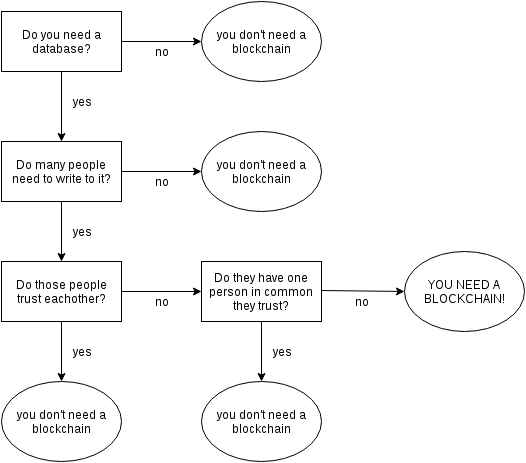
That's the ".../etc". Alt-coins/etc where etc is anything which creates a new pool of value which the developers skim off first. No one is seriously using blockchains for enterprise stuff because there's no reason to besides abusing the name for notability. If they're serious they use a database because as an enterprise there's always someone who all parties trust. Follow the flowchart. http://erewhon.superkuh.com/pictures/do-you-need-a-blockchai...
Enterprise blockchains ARE databases. They're private and they don't necessarily have a token attached. What you're talking about are public facing blockchains that uses a coin or token to create the new pool of value that you're referring to.
I really don't think this is it. I've not heard of many tech companies just shifting their existing efforts onto crypto. A notable exception are big tech companies that are used to making lots of bets, so of course they allocate some of their resources in order to dabble. Personally, what I like about crypto as an eco-system is that it has a very low barrier to entry and there is lots of room for scrappy startups. If a few people want to get together and and build a protocol or dapp to run on top of Ethereum, they can do so, deploy their code, and if the market responds positively to their project, they can start collecting revenue immediately.
All crypto are a scam. They can not be anything else because transaction fees make them a negative sum game. Everything else is just a lot of smoke and mirrors over this very basic and fundamental fact.
All non-cash transactions have associated fees--they're just obfuscated because consumers don't pay them directly. Visa takes 1.15% of every transaction, for example. There's no such thing as a free lunch.
Crypto fees are too high, though. The average ETH transaction is, I think, ~$6. That means it's uneconomical in the vast majority of cases.
Of course, everyone who uses it knows this, which makes for an odd scam, don't you think?
Using your standard the same is said of cash. It costs money to print it, labor to count it, etc. Currencies are almost always negative sum at least if you don't count the utility of the use of the currency itself. Maybe you can argue gold or something like that is excepted as it can be used as productive capital as catalyst for chemical reactions or as a conductor etc.
All of life is a scam. The net amount of entropy in the universe continually increases. Existence itself is a negative sum game. In a cosmic blink of an eye, the sun will swallow the earth and humanity will go extinct. Any meaning people find in life is just a lot of smoke and mirrors over this very basic and fundamental fact.
No, because both requirements you just stated are only attractive to criminals, terrorists, ransomware authors, billionaires and utopianists who have an unjustified extreme dislike of the state all to not pay taxes.
You mean criminals like drug dealers on the dark web? Or criminals like the people protesting against Lukashenko's rigged elections? Or even criminals like the endsars movement against police brutality on Nigeria?
I'm really sorry if this offends you but I think your opinions on tech and what constitutes a crime are really narrow. Perhaps you should check your financial privilege?
This article is a bit disingenuous. Optimism, Arbitrum, and Starknet are all part of the Ethereum ecosystem. Technically, Polygon PoS isn't, but Polygon zkEVM definitely is.
If you were following the pattern in the title, you'd say "Most operating system developers aren't working on Windows, Linux, or macOS". That might very well be true.
It's interesting to me that crypto is mostly the only place in tech where this (this is all a waste) is a widely accepted idea.
As someone else has correctly mentioned, ads (and tracking), are sadly the lifeblood of a lot of tech action and are arguably just as (if not more) exploitative. It's just slower and more subtle.
As for crypto itself, I get why it's not an attractive idea, and yes -- a very good bit of it is scam-city, but I'm compelled to admit that the cryptobros are generally correct when they describe the state of the dollar today -- even if their proposed solutions often leave much to be desired.
Is it though? 1% of the time an ad helps me discover an interesting product I wasn't aware of. That's still better than the value crypto has added to my life.
About 1% of the time I pay for something, I use crypto. That's better than the value ads have added to my life (which is negative).
Neither of our anecdotes cancel the other out. People can value different things, and that's ok! I'm amazed people spend their time telling others what they should and shouldn't value. I don't watch football and it has no value to me, but I don't go around telling people they should stop watching it too. If humanity were less self-centered and more empathetic, we'd approach everything this way, including football, ads, and crypto.
Ever tried to work for multiple countries with multiple banking systems? Total nightmare. When I was in England invoicing a US client required me to have a US bank account for them to pay (I ended up having to use an umbrella corp to make the payments easier as they had existing infra for a cut). Now I'm in the US when I invoice European clients payments take ages (2-3 days), when I invoice UK companies they tend to want to pay local bank accounts, and when I invoice Asia it's almost always a nightmare. USDC is instant, I can withdraw to my account in minutes, and the fee is lower. I know remittance payments from places like US to Nepal is far easier than trying with normal banking options. Even Wise still takes days instead of minutes for some transactions.
> I know remittance payments from places like US to Nepal is far easier than trying with normal banking options.
Okay, but the Nepal client still has to remit payment/receive payment with some source in their traditional payment system, so this doesn't really solve the issue unless they decide to operate all in USDC.
It's not a terrible burden coming from the US, but you've likewise offloaded the problem of having a US bank account onto me, where I now have to transfer my USD into USDC to pay you. It's not hard because I already have a Coinbase account, but it would take a few days for added funds to be released so I can send them to you. It's certainly not easier than something like Zelle.
Ultimately, nations aren't going to give up control of their money systems: China, for example, might use blockchains for a digital Yuan, but you can bet they will be holding the validator keys. Problems bridging between blockchains are as bad, if not worse, than problems bridging between traditional financial systems.
Point is, you're seeing a localized benefit from USDC because you've offloaded the problem of bridging between systems onto your clients, but that doesn't fundamentally fix that there are bridging problems. And even if every system moves onto blockchains in the future, that won't solve those bridging problems--in fact, it will almost certainly make them worse in the short run.
Ads impose a cost on everybody who sees them. People see thousands of ads per day, which to my mind is the psychological equivalent of breathing car exhaust and drinking lead-poisoned water. Crypto doesn't have nearly the reach, though I agree it's similar (on a smaller scale) in its waste of talent and its enrichment of careless, greedy, unscrupulous people.
Assuming that 1% is even true (I'd say that's an overestimate), the other 99% of the time, ads are distracting, misleading, and manipulative, all in ways that are bad for your mental health because they make you feel like you're not safe enough, your life isn't interesting enough, you don't have enough, etc. Even if, like me, you're fastidious about unsubscribing from ads and blocking ads, advertisers are adept at shoving their shite in front of you in violation of your consent.
Cryptocurrencies are pretty bad, but at least if you ignore them, they don't find you and directly harm you.
I think I have to reluctantly agree. At least you can mostly just ignore “crypto” (unless you’ve been in the market for high-end graphic cards I guess), which is more difficult to do for ads. Ads also cause the engagement maximization dynamics of social platforms, dynamics which arguably have turned out to be a huge societal net negative.
But you can’t ignore its effects, such as the environmental impact. If cryptocurrencies had zero effect on the people who don’t use them, there wouldn’t be such a large opposition.
You are right, but I believe that ads are overall still much worse in their negative effects. It also wouldn’t surprise me if ad tech consumes more energy worldwide in browsers than bitcoin mining does.
Debatable, but also a false dichotomy. Being punched in the arm is better than being punched in the nose, but that doesn’t mean any of them is positive or should be welcomed.
Most blockchains aren't highly used. I agree it's good we're moving off of that, but until Bitcoin fixes its act, it's still a shockingly awful waste of resources.
I don't know. Market makers for stocks at least have real utility. If I own 10,000 shares of $some_actual_company and want to sell it to buy a house, it's good that there's someone who's constantly pricing the stock.
In small European stock exchanges without HFT actors, buy/sell spreads on individual stocks can get large and daily volume very small, so you need to do more planning around any trade that's larger than "retail nickles". This is not great for attracting investors to these stocks, even if the companies are worthy.
But in crypto, there's no underlying value. There are no worthy companies who deserve more investor attention, no tokens that should be in anyone's long-term portfolio for any reason but FOMO. It's a 24/7 nothingburger outlet.
>There's no underlying value. It's a 24/7 nothingburger outlet.
That's not really true. It may not be everyone's cup of tea, and speculation may be driving most of price, but these are real tech products. Ethereum, Cardano, Avalanche, Solana are decentralized computing platforms, with utility. Uniswap, Aave are exchange platforms, that allow people to swap currency real time.
They may not be VMWare, Rackspace, JPMorgan Western Union or Moneygram, but they are real companies, with real products, that offer real services.
As of 2021, Allianz, Deutsche Telekom, Intel and Cisco are four stocks where investors that bought at the Dotcom Bubble peak never broke even. Maybe Ethereum, Cardano, Avalanche, Solana are far above their actual potential value, but it doesnt mean they are worth 0.
> That's not really true. It may not be everyone's cup of tea, and speculation may be driving most of price, but these are real tech products. Ethereum, Cardano, Avalanche, Solana are decentralized computing platforms, with utility. Uniswap, Aave are exchange platforms, that allow people to swap currency real time.
That is still speculation and most of the existing financial system can do payments (the supposed original use case) already.
Take a look at UPI, Pix, etc. A safer, faster and better future of payments is already being built and used to the tune of hundreds of millions of real people. And it is not a complete pyramid scheme.
That cannot be said for crypto, nobody is using it for anything other than speculation, crime and ransomware.
Isn't this expected. Bitcoin seems like a completed project, you can fine tune it to get better perf, fix security issues. Any significant architectural change is basically impossible now without breaking backward compatibility. Not only that, you have to persuade miners to use the new code. I remember the hate around increasing bitcoin block size to 8MB (to allow for faster transaction processing, on par with debit cards), which lead to creating Bitcoin Cash fork.
Bitcoin is like git basically, it works, most of the crypto fans are happy with it. Non tech people are using nice UIs without any understanding what happens to their money.
OTOH I have friends that work "around crypto", they either work on new coins that provide privacy/speed/eco-friendliness or create exchanges or create other financial stuff like crypto robo-advisors that buy/sell according to user spec algo. The scene looks similar to what hedge funds are doing on major stock exchanges.
Solana transaction fees are fractions of a cent as you can see.
Portal, which my cofounder snd I wrote, supports Solana’s transaction priority fees (which still costs less than a cent), which gets transactions into blocks faster, so less than a second as you saw in the video.
The transaction fees are based on compute rather than amount which you probably know, so it could have been a million USDC and the price would be flat.
USDC is considered the best capitalised stablecoin and Portal defaults to it (or EUROC in future) because we care about payments more than speculation.
Moody’s just announced that it intends to rate stablecoins which may help (if you more ratings agencies) but yes totally agreed around audits or proof of reserves.
I think eventually someone like Block, paypal, apple or google will make their own USD-backed stablecoin with low or zero fees and tie it into their existing nfc/payment ecosystem and it will be “trusted” since its from a recognizable tech brand and not some obscure crypto group that only gives product updates on telegram lol
One question I have in all of this: are people building and using these apps actually marking all transactions as capital losses or gains? [1] A big thing that stops me from even playing around in these systems is not wanting to deal with the tax hassle.
This article is a bit misleading for those who may think it’s saying most people are now coding with esoteric languages like Move or Clarity … the Ethereum Virtual Machine is an open standard and Solidity is a language and that is what is used by the vast majority of smart contract developers, even if they deploy to Polygon. It is a bit like saying most web developers and hosting companies aren’t using PHP because they are using PHP-FPM.
Most HTML developers wrote gaudy sites <blink> and <marquee> tags. But the Web went on to create trillions in wealth for the world because it was based around an open protocol, HTTP.
Most PHP developers wrote insecure garbage code, but back then businesses wanted to just have a site that works. It had some utility. But Web 2.0 went on to create even more utility for the world, even though its network effects increasingly created monopolies.
Ethereum really democratized the ability to launch a token. So that’s what the vast majority of people did. Eventually there will be real applications worldwide, and what’s more, they will be produced by factories (like UniSwap) so they’ll just be a very reliable way to distribute open source software. People don’t appreciate that smart contracts can do a LOT more than that!
https://intercoin.org/applications are examples of open source smart contracts designed to service communities, and you don’t need a token to use them. There is no ponzi, only utility. Just use them in your community — or not.
However, the last 3 years during the bull market speculators found Intercoin very uninteresting, because by contrast a tulip mania could make a lot more returns, than selling actual products to communities.
Publishing of information, distribution of information, self service, and facilitation of services were very long standing problems before the web. The web solved them cheaply and easily and it did it by design, not by coincidence. It didn't need artificial hype because it was obvious what it was good for.
I didn’t even say cryptocurrencies. I said smart contracts. There are myriad applications but in essence what Web3 smart contracts do is secure some sort of community activity on the blockchain to make sure everyone knows the deal and no one can cheat.
It only becomes important once the community grows enough to start securing something valuable. Like for example a marketplace that connects online students and teachers may be holding $20M in credits and you are trusting every employee to not misappropriate these credits. With Web3, the marketplace is just a Web2 interface that sets up the transactions, but at the end each user signs them with their own private keys, so the marketplace site has no liability nor presents a risk to the participants. Its commissions, like all other business logic, is immutable on the blockchain.
Elections - you can make sure that no one can just go in the database and change all the votes, as they can with Stackoverflow moderator elections for example.
Contests
Escrow payments
Auctions
Recurring subscriptions
You can combine them, for example you can make videoconferencing slots on your calendar which people around the world can book, to do office hours with you or take your course. People would bid on the slots and you’d take the top 10 people.
Crypto takes care of all this and around the world. It is like if you asked “what does the Web do, since we have newspapers, magazines, radio, TV”? The answer is that it standardized communication on an open protocol called HTTP. So it allowed anyone to publish information for anyone else in the world to access.
Smart contracts also represent a rebellion against having to trust institutions and governments. Now we have an alternative. The Web 1.0 democratized access to information, Web 2.0 allowed people to communicate and collaborate (but sadly didn’t democratize it) and Web 3.0 is radically open source and allows people to exchange value and participate in programs that don’t require trusting middlemen. The more complex the application, the more you as a network win by trusting the blockchain and smart contracts alone.
Start by clicking the link above if you want to get more examples of applications. Cryptocurrency by itself is just a first generation toy like space invaders or personal home pages. The space will evolve, and you can bury your head in the sand or you can spend 3 mins to click a link.
Here are some more applications that increase donor and investor confidence and break down global barriers:
No, you are totally wrong, and they don’t all require external trust, any more than sending emails requires last mile mail delivery. Yes, some things require physical items to be shipped but increasingly the value has been completely digitized.
What makes you think I haven’t researched the oracle problem and hundreds of other things related to this space? Vitalik writes about tons of things in crypto, and so do I. I have been building solutions for years.
They are FREE. If you don’t like them, don’t use them. If you don’t have time to even read a summary digest of what they do, please don’t patronize others. I don’t have time to read about how GPT transformers work in detail, and you won’t find me condescendingly telling people to please read up on the AI alignment problem. And certainly not knee-jerk dismissing and downvoting EVERYTHING related to AI without even spending a minute reading answers to mu own questions !
100% of users have to trust the code used to generate random numbers for private keys they care about isn't backdoored. Only a subset of users will be able to do this successfully. There is no safety net or recourse for people who will lose their money to backdoored refurbished hardware wallets. Because poor people won't be able to afford newer wallets and will be scammed. There is no good solution to this problem that is actually usable by all classes of people who need financial services.
I recently left a company that pivoted hard to building blockchain infrastructure because I couldn't find any way I could ever recommend my friends or family interact with the services the company was building. A lot of people are holding out for technical vaporware to solve these problems. I can't hold out anymore.
Well, this is the Trusted Computing Base. You trust Apple and Google every day with the devices, OS, browsers etc. They can impersonate you, and sure, you can say that for this reason we cannot have finalized transactions (because they can always be disputed).
But you’d be wrong. First of all, each participant can control a small portion of the overall value (eg one vote in an election, or one student paying one teacher). Even if their keys are hacked, the real value is for the network itself to be secured. And the business logic to be followed no matter what! No corruption of the database, ever!
For example, UniSwap is a smart contract factory and you trust every instance that comes out of it to be an battle tested and heavily audited piece of code you can trust. As of right now we are forced to trust the value and control of YOUR ENTIRE NETWORK to a big tech company that has all the infrastructure. That’s the best we have today, like how we trusted the Post Office to deliver mail and not tamper with it, until SMTP got adopted over the Internet.
There were MPC experts at the company I was at. We talked a lot about account abstraction design for our stack we were building. I'm not unfamiliar with anything you are suggesting. I'm saying there are classes of users for which there are no good solutions.
Sure different people have different threat models. Perhaps some classes of users don’t have good solutions, but we are building apps for the mainstream.
Some of the comments here are like you are not even trying to understand cryptocurrencies and blockchains. Its like you just got scammed by trying to get rich fast and now all of a sudden every single crypto is a scam to you.
To the people saying theres absolutely no use of cryptocurrencies, say that to people who were able to save some of their money when fleeing war torn regions. Tell that to people who whos pay-checks are getting stolen by banks. Tell that to people who are finally getting access to loans in impoverished regions. Tell that to activists banned by governments who get to fight another day. Tell that to people who’s governments devalued their currency who has basically got cut out of a way to trade.
Yes criminals use crypto! But these crimes didn’t magically appear because of crypto. Dont forget fiat has had a monopoly on these crimes before 2009.


I'm not saying there aren't good new ideas in new alt-coins/etc. I'm just saying if we're making a big deal about the number of devs, the above is the main factor.