What a fantastic initiative, the before and after pictures, especially the one after five years show an incredible transformation, it is hard to believe it is the same spot! Congratulations on a job very well done. It's the most literal example that I have seen in a while of improving the world around you. This sort of thing scales very well. What surprises me about the whole effort is that the municipality allowed you to dig up their sidewalks and to limit their width.
Here in NL that would never ever happen with a permit. Lots of in-ground infrastructure and serious risk to that if you start digging around in that without the right maps and access to various IT systems to indicate where you can safely dig, where you absolutely can not and where the pavement and the water management interact. So there is a lot of miniature guerilla gardening happening here, with people flipping up a couple of tiles in the pavement and then planting all manner of stuff there. It works and has a nice effect on the surroundings as well but it stops short of such transformation.
> Here in NL that would never ever happen with a permit. Lots of in-ground infrastructure and serious risk to that if you start digging around in that without the right maps and access to various IT systems to indicate where you can safely dig, where you absolutely can not and where the pavement and the water management interact.
Would digging for a garden be deep enough to reach that infrastructure?
Water pipes should be below the frost line. Google is failing to find me any frost line data for NL, but in places in the US where it tells me the climate is very similar to NL water pipes have to be at least 2 ft down.
If codes for power cables are at all like those in the US, I'd expect power to be at least a foot down, unless it is metal conduit. If it is in metal conduit you should be able to find it with a metal detector so you can avoid digging into it.
Those should all be deeper than you would typically dig when making a garden, except for electric lines in metal conduit.
That very much depends. There is a ton of shallow fiber and a well placed shovel would cut right through. I've worked with a company that sells software to manage infrastructure and the amount of stuff in the ground is pretty impressive.
Personal experience: 380V feed 40 cm down (too shallow, but: old cable), sewage shallower than that because the main pipe was itself too shallow and this was an old vacuum system (newer ones are usually positive pressure). Stuff also doesn't always stay at the depth at which it is buried and sometimes there are repairs which end up less deep than you'd really like to have them because you don't want to dig up a bunch of stuff around it as well.
I'd be very wary of sticking a shovel into the ground in a city without having access to the relevant data. Keep in mind that you may be held liable for any damage.
Hi Neighbor! I walk by your garden a few times a week and always enjoy it. I also have long been curious what the history behind the oddly shaped building was. Thank you for the blog post and for making the neighborhood a lovely place to live!
When the building was built in early 1880s Harrison was a major railroad line. The front of the building, as far as I can tell from contemporaneous surveys, was occupied by a small grocery with a shopkeeper's apartment in the back.
Another is that the roof was used to channel rainwater into a single downspout that could be easily captured.
Either way, it is unusual. Butterflies didn't really emerge in the US until the mid-century modern movement in Southern California and then they were mostly style.
First, the website is clean and minimal. However, as the scroll is confined to the contents broken up into columns (I'm on a Desktop with big screens), can you please (I think) add a think vertical line to let the reader know the content is bound there and hence bring their mouse/pointer to scroll within that content. I could not scroll while I was away from that specific content area.
I have seen this type of gardens in San Francisco. I thought it was a common thing - something weird and odd but nice. A garden on the roadside, and not part of a home/building. There is another which I pass every time I took my walk. This is in the block next to the recent under-construction building fire in Hayes Valley, somewhere between Oak and Page. The garden is on the roadside, they aren't selling the flowers, it was kind not attended much and was locked.
Thanks for pointing this out. I toggled some Obsidian Publish settings and scrolling has improved; still not perfect, page doesn't scroll if your pointer is in the the TOC column.
I had this same problem and thought the page was frozen for quite some time.
But what a lovely sidewalk! Sometimes I think about what the world would be like if we had no wars, no crime, etc. Think of all the resources we could put towards good things. We could afford to have every street look like this.
Where I live, it's impossible to get a permit for such a large area. But people are encouraged to dig up a small piece of sidewalk (~30x60cm) and plant stuff, mostly vines. It's not as impressive as Zach's project, but it can look pretty nice [1], especially when lots of people contribute. It's a cheap and easy way to add some life to an otherwise desolate cityscape.
That's right next to where I live, the city also installs slingers across the street for free if you ask for it.
My main problem is once you have plants dogs start pissing on your walls and door. And apparently their owners did it normal.
The plants that can tolerate that are mostly full sun so not suited at my place, so the ground ends up barren with piss stains on the wall. But climbing plants are fine and pretty nice.
Beautiful, thanks for the lovely garden and knowledge share. We recently added some plants in front of our home in the Mission but still have a ways to go - seeing this is really helpful and inspiring.
And since it's randomly/incredibly hyper-relevant, I'll plug this petition to save a Florida St sidewalk garden: https://chng.it/frXFyYNYKh
Very nice. Love it. Interested to know how the Safari Sunset Leucadendron is doing in your region? Living in South Africa I've tried to establish a Safari Sunset plant in our garden on three occasions, and they seem to be very fragile, however I've been wondering if the nursery's environment is too protected, so that when in the garden they fail when exposed to elements.
Lovely to see, but be prepared to have a plan in place for dealing with it in case it’s at risk if becoming kindling.
Having combustable matter within several feet of a building is one of the major risk factors when it comes to fire propagation through settlements, as demonstrated by the most recent firestorm in the news.
Had an ancient neighbor in downtown San Jose, would totter up and down the street stealing plants, putting them in her garden. What could you do? She was like 97, registered number 5 or something on the national Widows of the Veterans. Her father had fought in the US Civil War.
Though I wonder where the line is: obviously uprooting a whole plant is wrong, but is there a point in the size of a plant where one can take a cutting (or seed pod when/if it bolts into seed) to root/seed yourself?
Removing any amount of living tissue from someone else's plant, without their permission, is wrong. It's ridiculous to think it's ok. Buy your own, and cut it up.
Not true! Most urban environments, anything from the public path is fair game. And for good reason. The sun, air, rain aren't personal property. And the right-of-way is for everybody.
And in the US in national parks, picking fruit for daily personal consumption is also allowed. No hoovering up the entire raspberry patch to make jam at home! Just during your visit.
Only $24k for 800 sqft of construction. A lot less than I would've guessed. It would've been $240k if it was done by the government with 12 planning meetings and corrupt contracting bids.
I wish they broke down the costs. Sounds like a lot given than it excluded the concrete sidewalk, but maybe some of the plants cost a lot. The cost of a skid-steer rental and disposal of old concrete likely added up. Or (a) yard(s) of river rock and triple-mix cost more than I think.
which... depending on the fertilizing and amount of it, might be beneficial for the plants. And better for the public good than a totally impermeable surface.
“Incredibly rich people made their environment and those of their rich neighbors better.” Great. But it does nothing for Oakland, or Richmond, or the kind of neighborhoods I can actually afford to live in (but still not buy a house in). I guess it’s okay if we keep making everything nicer for the elites and worse for everyone else?
I see the property deeds of the rundown apartments and tenement housing in my neighborhood. They are invariably owned by rich individuals and investment groups from far away in very upper class exclusive areas. I never see these owners do even the slightest gardening, sidewalk improvements, they won’t even fix the basic items of heat, water, building codes that they are legally required to do. Instead, they use their outsized slumlord profits to buy and remodel their own multi-multi-million dollar properties and leave the rest of us to rot.
Forgive me if I’m less than enthusiastic to cheer on the rich improving their neighborhoods and ignoring the rest of us.
New trends tend to follow an S-curve of adoption and rich people tend to be the ones financing the leading edge of that adoption before it's "popular," when it's still hella expensive and the bugs have not yet been worked out.
I, for one, welcome this type of "bad behavior" by rich people. It might eventually trickle down to neighborhoods you can afford, assuming it starts somewhere and that somewhere will probably be with the folks most able to afford to take a risk and to indulge their whimsy.
I did some gardening in every cheap apartment I lived in as a broke grad student in the East Bay. Yeah, landlords aren’t going to do it for you, but that doesn’t have to stop you. Planting a small garden can be pretty cheap and is a huge improvement to the experience of living in most rentals, even if you’re only there for a year or two. Even got a couple of my landlords to let me deduct material costs from rent.


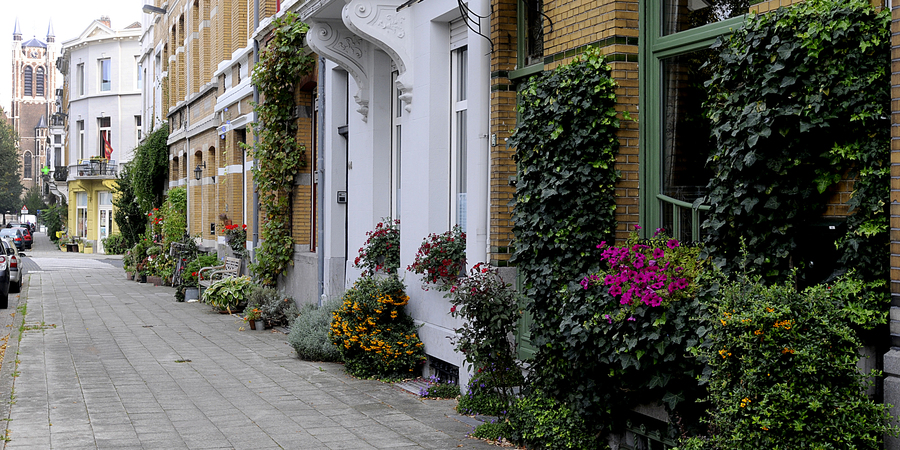
Here in NL that would never ever happen with a permit. Lots of in-ground infrastructure and serious risk to that if you start digging around in that without the right maps and access to various IT systems to indicate where you can safely dig, where you absolutely can not and where the pavement and the water management interact. So there is a lot of miniature guerilla gardening happening here, with people flipping up a couple of tiles in the pavement and then planting all manner of stuff there. It works and has a nice effect on the surroundings as well but it stops short of such transformation.
Sample from Amsterdam, much more modest in scope:
https://www.google.com/maps/@52.3743925,4.8971164,3a,75y,183...