Exciting to see this - so many advantages to pebble bed nuclear reactors including inherent safety (no risk of meltdown), use of helium coolant, ease of waste recycling disposal and continuous refuelling by simply adding more pebbles to the hopper.
Illinois Energy Prof has an excellent YT channel on energy, and has a great talk on IV gen reactor design. Saw it 4 years ago, so pumped to see some of the ideas he was talking about get plugged into the grid
If this helps China ween itself from coal faster then it's a huge win for the entire planet.
I know there's a lot of hate for nuclear (much of it understandable), but if we hadn't fucked it up in the 70's then climate change would not be a thing right now.
Yes, renewables and energy storage are good things too but the modern world is built on cheap energy and the more the merrier.
Side note: I became enamored with LFTR when it started getting promoted back in the day and I still think that too would be worth tackling.
You know, if parts of your country are as south as the Sahara desert, it just makes a lot of sense to install solar. Just like solar makes a lot more sense in the US than in Germany, which is more to the north than all parts of the US except Alaska and the most northern parts of WA/MT/ND/MN.
I am as pro-solar as can be, and am thrilled by the decreased costs and increased installation.
I think every building where possible should have solar on it. Carports, agrivoltaics, etc. It's a no-brainer in addressing climate change, reducing energy costs, and more self-sufficiency.
But not all the world has such solar profiles and there are also (addressable) issues with solar (storage, grid integration). This isn't a "pick one" problem. It's about feeding an energy hungry planet without cooking it, and every non carbon source should be embraced.
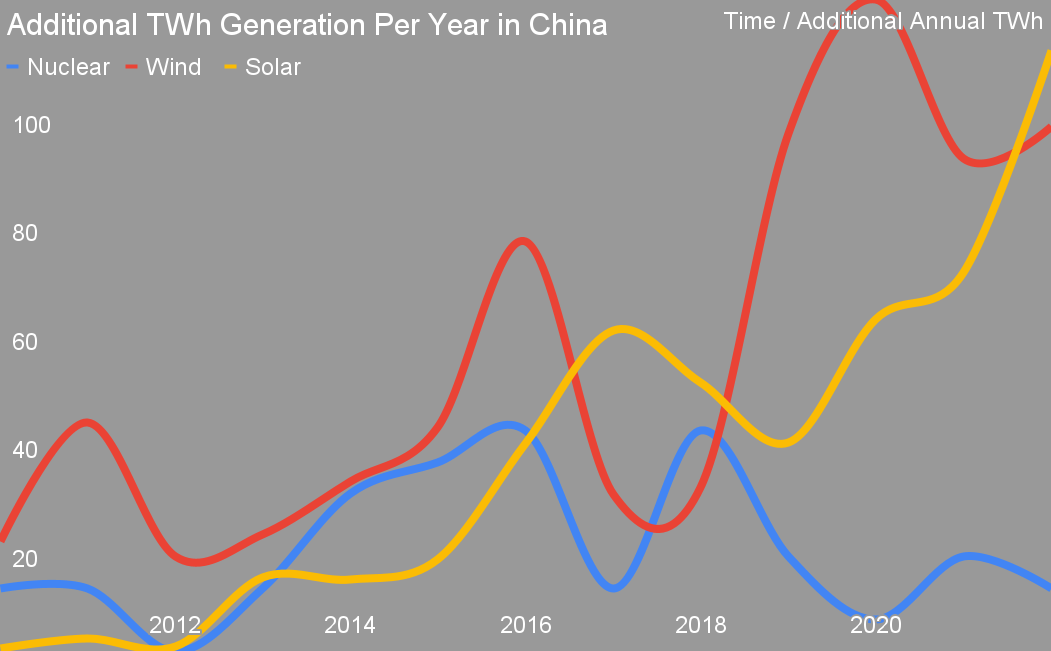
China is building vastly more solar and wind than they are solar. And nuclear construction has slowed down noticeably as wind+PV has accelerated in the past few years.
The International Energy Agency (IEA) World Energy Outlook 2023 report outlines China has having an extensive expansion of both nuclear and renewables driving a decrease in China's coal use mid this decade.
It also asserts that China is behind 30% of all new nuclear power builds (under construction).
That provides nothing of substance without an attributed source for the raw data.
Taken at face value it shows 40TW or so coming online every four years or so, although the graph was created by an inummerate *.
* Here's a good question for you: why (on earth, why!!) would anyone put a continuous spline through additional power stations coming on line (very discrete, very burst data)?
If it's all the same to you I'll stick with the IEA assessment.
An aot comparison is that China added more wind and solar the past nine months than all of its nuclear reactors under construction will provide. Yes, that includes capacity factor.
I have no doubt that China's renewable energy additions outweigh its nuclear additions - that's covered in the IEA report I cited.
The claim made above that I responded to was:
And nuclear construction has slowed down noticeably
which I've yet to see supported by a credible reference.
Even if the awful chart is correct in it's raw source data it only addresses recent nuclear power coming online and not the amount currently under construction ... which may be more, less, or about the same as past construction.
If it helps I'm ambivilant about nuclear V solar other than pragmatically recognising that renewables need a small constant baseload given human consumption (which is a whole other discussion), however I'm always alarmed about figures thrown about with no credible cited data .. and awful awful charts make me queasy.
China’s new reactor construction has slowed in recent years, and their deployment of wind and PV has surged.
I’m fascinated by this because I think it’s going to be one of the most important stories of the 21st century. I’d be fascinated as well if things were going the other way.
This is the point of the chart I grabbed from a collection of thirty similar charts, solely because it illustrated the same trend with slightly more recent data. You can verify these facts easily yourself in less time than it takes to post to HN, from any number of sources (which will also give you the number of reactors under construction, etc.), there’s no need to pose easily-answered questions implying that maybe the trend is incorrect due to other factors, when you can easily satisfy your curiosity about those factors with a few minutes of research. TL;DR: more intellectual curiosity, less noisy argument.
> You can verify these facts easily yourself in less time than it takes to post to HN
But can you?
Is the source official chinese stats, independant IEA auditors, the people that put out the nuclear red book .. do you even know, that is the question.
> China’s new reactor construction has slowed in recent years
Is that construction or completion (I trust you understand the distinction).
Is that in total (global nuclear reactor construction by china) or local (just those within China's mainland boundaries).
> the chart I grabbed from a collection of thirty similar charts, solely because it illustrated the same trend with slightly more recent data.
Read that back to yourself and ponder how that sounds.
TL;DR: more intellectual clarification and honest revelation of raw data, less unsourced random opinion | charts.
Exactly. You should use the IEA data about Chinese mainland reactor construction, because China’s civilian reactor construction plans are very public and reactors are big enough to see from space. Go review that and stop posting and downvoting here unless it says something substantively different than I explained in this thread.
China is also building enough renewable power than their grid expansion rate leading to a structural decline in CO2 emissions [1]. At the same time the utilization factors of the coal plants reduce each year.
This is driven purely by economic factors, for the first time since the discovery of fossil fuels, except the blip where we dammed up pretty much every single river globally to provide hydropower, we have in renewables have found a new cheaper energy source.
Honestly the hate for nuclear isn't understandable at all.
It has killed very few people, expense isn't a reason for hate, and everything else has pretty much been a win (land usage minimal, minimal byproducts, etc).
The Chernobyl exclusion zone is large because it was predominantly rural wilderness to begin with and no one cares to demand that more of it be opened up or cleaned up or otherwise have anything done with it.
The Fukushima exclusion zone is currently 143 sq miles, and half of the original Fukushima exclusion zone (a radius around a plant situated on the coast) wasn't on land. Based on the difference in capacity factor between nuclear and solar, a solar farm with the generation capacity of the Fukushima nuclear power plant would require approximately the same amount of land as the height of the Fukushima exclusion zone (including the parts over the sea), and about twice as much as the current exclusion zone.
Needless to say there are several hundred other nuclear power plants that have operated for decades and have no exclusion zone, even before you consider newer designs that reduce or eliminate the possibility of that failure mode.
Fusion power research in the EU is going to cost something like 100B euro for ITER + DEMO. No useful amount of power production is planned for decades.
Meanwhile, that money could have purchased solar + wind that would provide something like a third or even half of Europe’s electricity needs! That’s not even factoring in ongoing cost reductions over those same decades.
Fission has the same problem: it’s expensive power in the distant future versus cheap power available now.
The same argument can be made for any r&d, in lieu of spending on alternative technology that already exists. Should we have stopped spending on mRNA vaccines to pay for more socialized healthcare? Or more efficient batteries for better public transport?
No one knows the answer to any of these questions because the outcome of r&d is unknown. Some known unknowns but also unknown unknowns. So we do both/all the things to some degree and optimize the degree as we learn more. Alternatives are mostly not mutually exclusive.
More to the point, research is valuable for the indefinite future, whereas some particular power generator is only valuable during its operating lifetime.
Powering half of Europe for three decades sounds like a lot until you compare it to powering all of humanity for the next hundred thousand years.
Indeed, that's a false dilemma. I could just as well have argued that the money has gone to bailing out banks, or to funding the war in Ukraine, or whatever. Not to mention that money itself is a social construct; it is created by banks and/or the state. If a (sovereign) state wants to, it can print money. Of course this has risks, and sometimes results in currency devaluation (not as frequently as some believe), but it's another way in which one can't claim that "country C invested this much money in A instead of investing in B".
for me it's distrust of private companies to take public safety seriously even with regulatory oversight. the costs of failure are bigger with nuclear.
Human health cost of global warming isn't exactly cheap. Delayed costs are still costs. It's just my generation and my kids who have to pay while my parents generation reaped the rewards and profits up front.
I, like many of my peers feel like we are being grifted by the boomer generation.
You're also reaping the advantages produced by the boomer generation in technology, medicine etc. to which they themselves did not have access (or had, but much later in life).
In any case, it's disappointing to see how people are so quick to jump at any opportunity to stereotype and hate a group of people, this time not identified by their skin, but their date of birth...
That bit is obvious. The next generation benefits from the innovations of the previous generation.
But boomers knew about global warming, and refused to do even the bare minimum to help curb it. (More highways, gas guzzlers galore, effectively ban nuclear, anti sustainable urban development)
Even the one positive assertion comes with asterisks. The boomers oversaw a lengthy defunding of federal programs while wealth kept accumulating at the very top of this nation. So the resulting economic benefits haven't been all that useful to the rest of America.
Ofc, no individual bears the sin of an entire era. But we need to recognize the inherent selfishness of that era nevertheless.
How does it's cost to install and operate compare to gen 3/other nuclear tech? Safety is great, but nuclear is already safe enough (in the sense that, installing current and even last gen nuclear saves more lives through fossil fuel displacement than it can plausibly kill even in worst case disaster scenarios). Continuing to make nuclear safer, if it results in higher costs (and therefore reduced installs) is a bad tradeoff and has been for close to 50 years.
Is the uncaptured power completely gone during processing or does it remain embedded in the "nuclear waste"? It is not hard to imagine a future in which that waste gets mined to be put in a new reactor when the political/economic winds change.
Nuclear reactors must meet stringent safety standards, not with hand-wavy "but people die from fossil fuel pollution" rhetoric; and at the same time, fossil-fuel-fired plants must be made to emit a lot less, through filtering and other technological means.
Safety is not a binary, safe/dangerous. How much risk we are willing to accept and what the trade-offs are isn't something that has a correct answer. it's a values question.
My comment was assuming that society's apparent risk calculation was evident in how we treat everything other than nuclear. If your argument is that our safety regime on nuclear is correct and everything else is too dangerous and needs to be made safer, well I personally disagree but at least it's consistent and I have no problem with your opinion. It's a difference in values.
The real problem I have is people who think that nuclear is a special flower and needs to be held to different standards than everything else. Which is how society is currently acting. And it's killing millions of people every year.
Nuclear is a special flower, in the sense that the worst-case malfunction scenario in many reactors is a chain reaction which leads to widespread dispersion of hazardously radioactive material, be it with or without a massive explosion. In other words, the "L_infinity norm" damage potential of nuclear is higher than coal, solar, wind, and perhaps even hydro (although dam breaches are quite lethal).
It's also true that if you take the "L_1 norm", i.e. the expected damage, it may well be a regular flower and not special (perhaps even less-special than coal for example). But then it's a game of trust with the kinds of companies and state institutions which in many countries have proven as untrustworthy in preventing industrial / infrastructural accidents.
Nice to see one in operation. Anyone know if they move the LCOE needle?
For reference, traditional nuclear is 4-6x as expensive as wind/solar, and wind/solar are still dropping. For baseload the gas turbine still beats the pants off of nuclear.
I think nuclear needs to get to 2-3x unsubsidized to be relevant long-term, but that's a long road.
> For baseload the gas turbine still beats the pants off of nuclear.
Not if you price carbon.
> For reference, traditional nuclear is 4-6x as expensive as wind/solar, and wind/solar are still dropping.
That's cost per MWh generated not accounting for when you need it. Renewables need both short-term storage and long-term storage.
If you generate with solar, what do you do at night? You'd need 12 hours of storage. Maybe that's economical in some contexts but it definitely raises the cost.
Now what do you do if it's cloudy or still for a week, or a month? 720 hours of storage would be crazy expensive. You could use natural gas plants or similar, but then you have to pay the cost of maintaining natural gas plants and the associated infrastructure that you only use 2% of the time.
1GW nuclear plant vs 1GW (average) of solar + 12GWh of storage + 1GW natural gas plant + rarely used gas pipelines or 720GWh of on-site reserves, which costs more?
That is just adding an arbitrary cost, so you can get any result you like. You can also put an arbitrary cost on land usage to make nuclear cheaper that wind or solar. Just a government doing its job, putting its thumbs on the scale to get the result we want.
A couple of points I can think of, 1) the Helium nucleus is exceedingly stable so the coolant won’t get radioactive from neutron activation, 2) the coolant being chemically inactive means you can use run the reactor at higher temperatures, thus achieving higher efficiency if you use the heat to run a heat engine (steam turbine).
It escapes into space and that's the main problem with it. But it doesn't create steam explosions and hydrogen buildup under ionizing radiation (also explosive). My main gripes with pebble bed reactors is not helium, but pebbles cracking, graphite fires and complications with fuel reprocessing. Helium just ads another layer of complications because it's quite scarce and easily lost. Also the installed capacity of this reactor is quite underwhelming. But it's nice that the Chinese have built it and are testing and advancing the technology developed in Germany during the '80s.
I am not an expert at this, but if I had to guess I would agree with your answer. Helium, even neutron enriched radioactive helium -if there is such a thing-, will evaporate into the air instantly, it will also rise to highest location being lighter than essentially every other atmospheric gas. This make it easy collect, contain, or cleanse, if performed. It will also rise above the atmosphere and get blown away by the solar winds should it escape the building. Additionally, helium is inert so it will not form other chemical compounds that will stay around, or enter the human body. Also because it is inert your body will not generally absorb it, certainly not like it would tritium water. Also comparing to water, helium will not dissolve other chemicals, radioactive or not, into it like water does. One last thing is the cooling potential of liquid helium is immense, being able to absorb massive amounts of heat during evaporation. Assuming they want to use a helium refrigeration cycle.
I’m no nuclear physicist (only a climate/math physicist), so I had to look it up. If a helium-4 nucleus were to absorb a fission neutron, it looks like it would transmute to helium-5, which has a half-time of 602 ys (yoctoseconds), and decays by neutron emission[0]. So pretty much status quo.
For context, in 602 ys, light travels a distance equivalent to around a hundredth of an atom width, so it’s a rather short moment.
One of the reasons for the HGT-reactors is the extremely high temperature. Helium is a lot better than water for things like that. The extra high heat means you can have a higher efficiency while having more heat left for industrial processes.
Glad they got a high temperature gas cooled reactor up and running!
I do dislike the terminology/categorization around 'fourth generation'. The first ever proposed commercial reactor (the Daniels Pile) was a pebble bed gas cooled reactor concept, worked on at Oak Ridge in the 1940s. We've built lots of gas-cooled reactors in the past, including helium cooled ones. Such as:
* Peach Bottom
* Fort St. Vrain
* HTTR
* Dragon
* HTR-10
* AVR pebble bed
* THTR-300
* Ultra-High Temperature Reactor Experiment (UHTREX)
Nitrogen-cooled ones, such as ML-1 and GCRE
CO2-cooled ones, like EL4, Lucens, AGR, Magnox
Air-cooled ones like HTRE
Liquid-hydrogen cooled ones like NERVA
It's kinda dumb to call this the first 4-th gen reactor.
Nitrogen cooled reactors produce copious amounts of 14C, unless you use isotopically purified 15N, which is quite expensive. Ditto for air cooled reactors.
> "The HTR-PM features two small reactors (each of 250 MWt) that drive a single 210 MWe steam turbine. It uses helium as coolant and graphite as the moderator. Each reactor is loaded with more than 400,000 spherical fuel elements (‘pebbles’), each 60 mm in diameter and containing 7 g of fuel enriched to 8.5%. Each pebble has an outer layer of graphite and contains some 12,000 four-layer ceramic-coated fuel particles dispersed in a graphite matrix."
Note that Chernobyl was graphite-moderated and water-cooled, but hot graphite and steam is a bad combination, tending towards the generation of (explosive) hydrogen and carbon monooxide gases during loss-of-coolant type accidents. The helium coolant avoids this process, and can sustain higher operating temperatures so has industrial uses, somewhat ironically in the petrochemical sector:
> "The major purpose of HTR-PM is to co-generate high temperature steam up to 500℃ and electricity. It is cost effective currently in the Chinese market to supply steam and electricity for the petrochemical industry to substitute the burning of natural gas and coal."
It seems like a pretty safe design with some unique capabilities, although it'd be interesting to see the total cost-per-pellet inputs (each 6 cm pellet generates as much power as 1.5 tons of coal prior to its retirement, but manufacturing each pellet is probably not that cheap).
A significant advantage of a higher temperature reactor would be if it could use the same steam turbines used in combined cycle plants. These are "dry" turbines that operate with high temperature (550 C) steam. In contrast, LWRs use "wet" turbines with saturated steam at temperature a couple of hundred degrees lower. They're about the only ones still doing so, I think, so the turbines are bespoke and do not benefit from the economies of scale of the CC steam turbines.
(550 C is the upper temperature limit for cheap steel against creep, so I think that choice of temperature is not a coincidence. It also makes me dubious of reactor concepts operating at higher temperature.)
Doesn't China building so many civilian reactors mean they are getting more experience and more specialized workforce in nuclear energy than anyone else? How can the west compete if most nations reject the atom and the ones who don't either have minuscule numbers or focus more on military reactors?
That’s only a big deal if nuclear was going to play a major role in the future, but the world seems to have decided on PV in a big way. The world is adding the equivalent of more than 100 nuclear reactors worth of PV solar per year even adjusting for differences in capacity factors. (~30% vs ~70-90%)
China gets roughly 5% of it’s annual electricity from nuclear, 5% from solar and increasing rapidly, 10% from wind, and 15% from hydro. It’s a token investment in nuclear that only seems huge because they produce ~30% of the worlds electricity.
PS: Also, don’t forget about the defense industry. We’re maintaining nuclear expertise even if the civilian industry fails.
It’s a little more complex, ~60% of panels used outside of China come from China. Thus current prices are just what it costs to manufacture not the result of some subsidy.
Roughly 37% of the worlds supply is by China for China, 38% by China for the rest of the world, and 25% is by the rest of the world for the rest of the world.
It’s silly. Next we’re going to severely hamstring AI research because of some insipid NYT lawsuit and let them run away with it too though we did all the research for it.
My own partisan comments on the pebble bed class of reactors (https://lvenneri.com/blog/pebble-bed-nukegumball) for those interested in a deeper yet still qualitative comparison of pebble beds and prismatic cores - the main types high temperature reactor. Long story short : pebbles offer significant disadvantages compared to prismatic geometries, summarized by this donald duck clip: https://youtu.be/shvwSBGDmE0.
I'm not sure who the intended audience is. Your arguments are technical enough that whoever is able to follow them will be extremely unimpressed by the linked Donald Duck cartoon. The fact that you do include it and think it improves your case demonstrates that you attempt to target the emotional side of your reader. I'll be honest and admit this is an uncharitable view. The charitable view is simply that you found this video and couldn't resist linking to it. But it's not good.
This reads more as a puff piece than an informative article. Hardly surprised coming from the "China Global Television Network". It just reads like "Everything going great, look no further".
And for somebody who has been following the development of 4th generation reactors, this one is rather non-exciting. Yes it uses a pebble-bed and higher temperature (hence VHTR), it's overall improvements are rather diminishing compared to Gen 3 designs. The meager output of 150m isn't exactly thrilling and the possibility for hydrogen production remains unused as well.
I don't want to be purely cynical. Every incremental advance is a form progression and can advance the status-quo as we know. But the most promising space is clearly happening in the Fast Reactor space, just maybe not the SFR, this is a nuclear disaster waiting to happen.
China has also started experimenting building commercial molten salt reactors so it'll be interesting what the fourth generation power plant shootout will look like.
As far as I understand, at least with some designs, the fuel elements have the property that it overall becomes less reactive above a certain temperature (that the elements can withstand without damage). So it's basically self- moderating, and the cooling system only has the job to extract the energy to generate electricity. At least that's the theory.
As I've understood it, the main risk of running a PBMR is that putting out a graphite fire is somewhere between very difficult and impossible. Does this particular design somehow address this ?
While I'm not certain about this system, it sounds like the fuel pellets they've designed for it have no graphite in them. It sounds like they've gone for an intrinsically safe design where the maximum safe temperature of the fuel composites is higher than the maximum temperate an uncontrolled reaction could reach.
Reading this as a German feels really bitter. Our government has cancelled ALL research into nuclear reactors. We are completely out of the race, and there is probably no way back.
You guys had some really nice reactors too. Not just the ones recently shut down, but gas-cooled ones as well (THTR-300), and the infamous sodium-cooled one SNR-300, which got cancelled by protests after it was 100% completed and fueled but before it ever turned on. It's now an amusement park :( :(
[…] the meltdown in Harrisburg in 1979, the Super-Gau in Chernobyl in 1986. The answer of the then Union-led federal government: Helmut Kohl creates a Ministry for the Environment, Nature Conservation and Nuclear Safety. Also a demonstrative sign to the Greens, who first entered the Bundestag in 1983, with the clear demand for an immediate construction and operation stop to all nuclear power plants.
Yeah... somehow it's hard for humans to compare normal operating combustion sources like fossil and biofuel killing ~8 million people/yr from air pollution while also causing climate change against a few bad reactor accidents.
1. Being on the front lines of the Cold War, in the event of a hot war, most nuclear weapons would be used in West Germany. (Yes, weapons aren’t power plants, but they can be hard to separate in popular discourse.)
2. Plans to build a nuclear power plant at Wyhl were opposed by locals, who occupied the site, and were forcefully removed by police. This was broadcast on television and helped galvanize the anti-nuclear movement.
3. The Chernobyl accident led to fallout being deposited on German soil, which furthered opposition, and in my view, was the killing blow.
> The Chernobyl accident led to fallout being deposited on German soil, A
That was long after the anti nuclear movement had gained full steam, not a reason for it. People in Poland or Bulgaria are not nearly that extreme in their thinking, even though they got a much bigger dose of the Charnobyl fallout.
But the severity of Chernobyl definitely fomented anti-nuclear sentiment much further than it had been. It “showed” that a major radiological release could happen in a civilian power plant (nonwithstanding that such designs weren’t used in Germany). Ultimately the formation of the sentiment was a process, of which Chernobyl is a core part.
That's what I am often wondering about. A large part of Germans have developed a completly exaggerated fear of nuclear energy, acting almost like cult or if they are in a mass delusion.
One example: When I say to some of my friends that I would be perfectly fine living near an underground long term storage facility for nuclear waste, they do not believe me or think I am a moron. They really think that facility could either blow up or the radiation will kill you in your sleep. And those are doctors, judges and other people with higher education. One influential German politician even claimed, that the Fukushima incident killed 16000 people, simply attributing most of the deaths from the tsunami to the Fukushima powerplant. And those people are now in power of this country.
I have no idea if this development was controlled by interest groups or they spiralled into that mindset themselves, which would not even surprise me.
there are many theories but I think being front-line for so long in any East-West confrontation is the most important factor - it was the reason Green / Anti-Nuclear / Pacific sentiment was much stronger in Germany than anywhere else in Europe. It's fashionable to dunk on Merkel these days but when she went against nuclear post-Fukushima it was with widespread support from the society.
Their environmental movement--and many others around the world--was against nuclear power. It's easy to forget now but fairly or unfairly nuclear came to be seen as a dirty energy source after stuff like Chernobyl, Three Mile Island, and Fukushima. Even now a lot of hardcore environmentalists are completely against any nuclear builds, favoring essentially only wind and solar (geothermal/hydro here and there but meh).
This is probably mostly right. I consider it worth noting that each single coal plant operating normally kills more people than Chernobyl, even in the high-end estimates, roughly every 5 years. I think the psychology of radiation is somehow a lot scarier than the psychology of particulate air pollution, for some reason.
So it sounds like all new things (that aren’t an idea or software) will come from China moving forward. I hate this but it’s interesting in a way to see how far they will get. The US supercharged the world for generations but now seems to have directed all its attention to feminizing its men. I wonder how far the Chinese can take it. Settlement on the moon? Mars? Generational ships headed out of the solar system? Anything seems possible with the mostly benevolent dictatorship they have going on over there.


Illinois Energy Prof has an excellent YT channel on energy, and has a great talk on IV gen reactor design. Saw it 4 years ago, so pumped to see some of the ideas he was talking about get plugged into the grid
https://www.youtube.com/watch?v=_mJ3S-VQuHY&t=490s for those who want to know more