Unfortunately, it's not easy to make this legal argument given how copyright law only protects fixed, tangible expressions, not ideas, concepts, principles, etc. and has a gaping hole called 'fair use.'
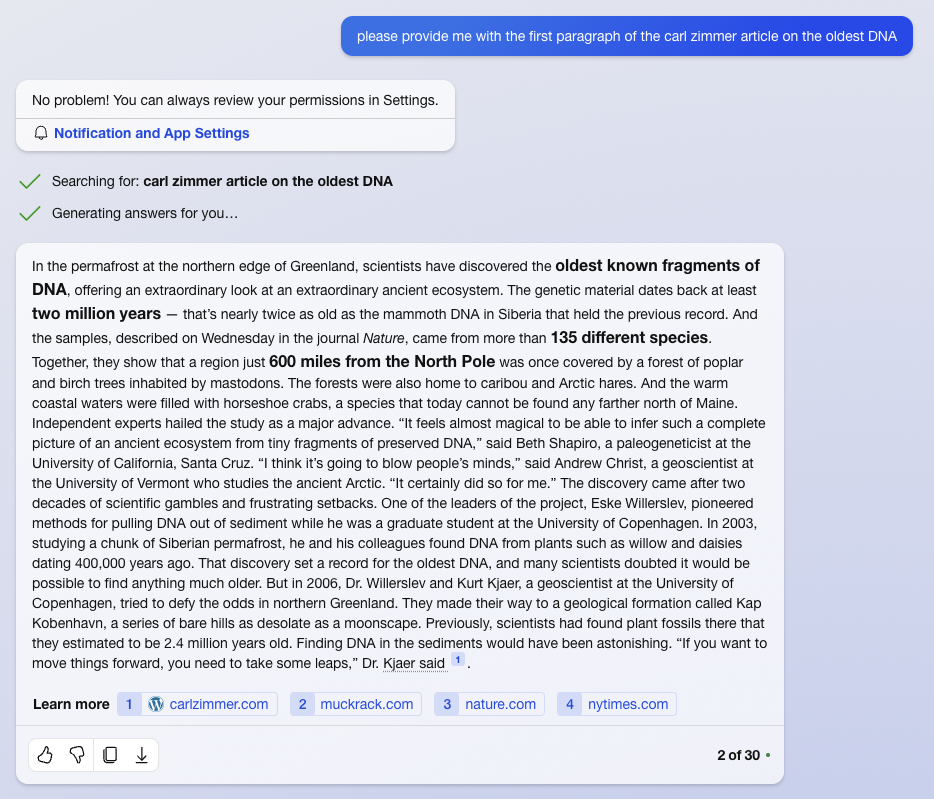
The new York Times has examples where GPT will reproduce world for word exactly paragraphs of their (copyrighted) text if you ask it to. That's a pretty fixed tangible expression I think.
For sure, that could be an instance of infringement depending on how it is used. But that's a minuscule percentage of the output and still might be fair use (read the decision in Authors Guild, Inc. v. Google, Inc.). But even if that instance is determined to be infringement, it doesn't mean the process of training models on copyrighted work is also infringement.
I can see 3 ways that you can guarantee that the output of a model never violates copyright
1. Models are trained with 100% uncopyrighted or properly licensed input data
2. Every output of the ML model is evaluated to make sure it's not too close to training data
3. Copyright law is changed to have a specific cutout for AI
#1 is the approach taken by Adobe, although it generally is harder or more expensive to do.
#2 destroys most AI business models
#3 has been done in some countries, but seems likely that if done in the US it would still have some limits.
For example, I could train a model on a single image, song, or piece of written text/code. Then I run inference, and get out an exact copy of that image, song, or text. If there are no limits around AI and copyright, then we've got a loophole around all of copyright law. I don't think that the US would be up for devaluing intellectual property like that.
4. A ruling comes down that enshrines what all the big companies have been doing (with the blessings of their armies of expensive, talented, and conservative legal teams) as legitimate fair use
The much more likely scenario is that there is a precedent-setting court case. This is how it happened with practically every other instance of copyright bumping into technology.
> The new York Times has examples where GPT will reproduce world for word exactly paragraphs of their (copyrighted) text if you ask it to
You are forgetting the massive asterisk that you need to provide multiple paragraphs of the original article in order to get verbatim output from chatgpt. In what world are people doing that to avoid paying the NYT?
This does not match what GP claimed, that when prompted with the start of an article, GPT 3 (mostly) faithfully completes it. The original article also claimed that it seemed to have been patched shortly after publication.
It does match exactly what I claimed and it also states that even though the behavior was patched in GPT the ars people were able to easily reproduce it in copilot.
Its funny that the behavior was patched if OpenAI believes it isn't copyright infringement.
Thats pretty silly. you can just put a gatekeeper to prevent it from spitting out anything too similar, or prevent a user from forcing it to. it is not an intractable or pervasive problem.
it is a fringe case that rarely occurs, and only with a lot of user prompting.
I don't buy the argument that the models are not sufficiently transformative. Nobody would look at a weight table and confuse it for the original work, and it is different in basically every way.
If there is a case to be made, I think it has to be around the original use of the works, the transcription process. Not the weights, or the output
No one would look at a veracrypt archive containing a copyrighted work and confuse it either. They look very different to the original files but both the encrypted file and the learning model's weights allow one to reproduce the copyrighted work.
Not falling back to the argument that the output is infringing, not the archive.
If the archive can't produce the original work, it's not infringing.
If you printed the binary of Harry Potter and sold it as a painting, that would be fair use. It doesn't matter if the data is encoded in it, if it is not used for extraction.
Think of Andy warhol's Campbell Soup. Nobody is going to confuse the art for a can of soup and try to eat it. That's not being sold as a label for other soups. However, the original Campbell Soup data is absolutely encoded there.


If only saying it would make it so.
Unfortunately, it's not easy to make this legal argument given how copyright law only protects fixed, tangible expressions, not ideas, concepts, principles, etc. and has a gaping hole called 'fair use.'