Think of it more as extra energy being imparted to the global weather system. This will have all sorts of fun and exciting effects, and as I understand the warming will be greatest at the poles. Alaska has warmed by about 1.6[0] in the last 60 years, and the interior of Alaska by 1.4° C in the last 100[1], compared to a global temperature rise of .8° C over the same period. This has resulted in the melting of thousands of cubic kilometers of glacial ice, with this study[2] suggesting that this is the largest glaciological factor in rising sea levels.
To the eyes of the native inhabitant, the glacial retreat is shocking, with the lower altitude glaciers most affected. We've built glacier overlooks in some places, where once the glacier was a stone's throw away, and now it's barely visible, and in another few decades the only thing they'll be able to show anyone there are photos. I've seen photos from the early 1900s of glacial termini which towered over the masts of a sail-rigged steamer. Today there is a fjord there, and the glacier is more than 13km away.
And you want to know what that feels like?
How about instead you imagine how it feels to watch the Arctic melting around you, while an endless circus of millions deny that it's even happening.
My apologies if you read any offense in my words; none was intended. Unless you happen to have a heat ray and a hatred for H20 solids, I can't imagine that you've had much of a personal hand in making it melty up here. I hope the data I provided may serve you even if my rhetoric don't.
While I've got you here, and while we're pushing the civil boundaries on the topic, there's something on this subject I'm curious about, but have always been afraid to ask...
Won't a more accessible / inhabitable taiga be kind of awesome?
I mean, low lying areas without hurricane protection swallowed by the seas, algal blooms, the shutdown of the thermohaline cycle leading to a frozen Europe, midwestern desertification, all these are well down the bad side of the ledger. Harms are still outweighing the good. But isn't some of what's going on up north good for humanity?
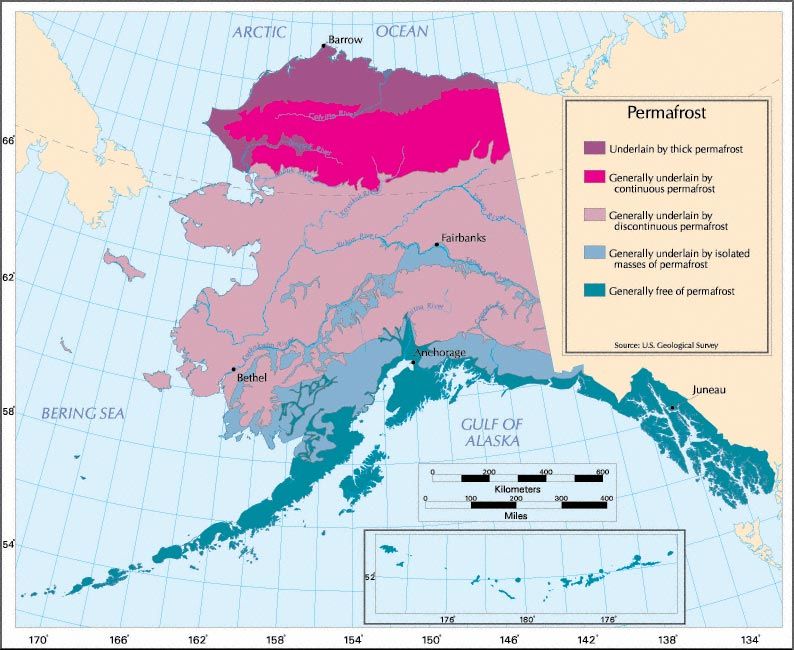
I complain about glaciers, but they're really just the tip of the icefield. Most of the ground here is some variety of permanently frozen (permafrost)[0], so that's all going to melt at some point. Most of the population here does not live on/near permafrost, despite that map. However, if you do happen to go to Fairbanks or some more northerly hellhole, you'll find all the buildings are built on stilts, elevated a few feet off the ground. If they were not, the ground underneath would melt and sink (ice is less dense, remember), and eventually you'd be making a nice cross-stitch for "Home Sweet Bog".
So there's that. There's no soil in most of Alaska; it's either been scraped away by glaciers or the frozen layer is too close to the surface for much to develop. In some places the pine taproots can only get a meter or so down, and you'll have endless forests of man-high spindly pines. In many other places there are no trees at all. This is generally what we call taiga. When the permafrost underneath this melts, you're not going to have fertile soil left behind, at least not for a really long time.
On the plus side, Alaskans are probably not going to complain a whole lot about a warming trend, and the Northwest Passage is finally a thing. Maybe my friend will finally be able to grow avocados? It's hard to come up with a lot of other things that might be beneficial -- maybe we'll have more opportunities for strip mining now that the glaciers are gone. Maybe in a few million years the Alaskan Bog will be a good source of petrochemicals.
Really it's pretty hard to come up with good things, especially compared to "most of the ground will melt". Siberia is likely to be much the same story, as well as large parts of Canada -- you can find your own permafrost maps for there. Oh, and we have problems with coastal storms here too, and are already having to relocate whole villages (Newtok, Shishmaref, etc)[1][2]. Probably the only really good thing is that not a lot of people live here now, otherwise it'd be pretty easy to call the Arctic as the region most severely affected by AGW.


To the eyes of the native inhabitant, the glacial retreat is shocking, with the lower altitude glaciers most affected. We've built glacier overlooks in some places, where once the glacier was a stone's throw away, and now it's barely visible, and in another few decades the only thing they'll be able to show anyone there are photos. I've seen photos from the early 1900s of glacial termini which towered over the masts of a sail-rigged steamer. Today there is a fjord there, and the glacier is more than 13km away.
And you want to know what that feels like?
How about instead you imagine how it feels to watch the Arctic melting around you, while an endless circus of millions deny that it's even happening.
[0] http://climate.gi.alaska.edu/ClimTrends/Change/TempChange.ht... [1] http://oldclimate.gi.alaska.edu/papers/Arctic62-3-295.pdf [2] http://glaciers.gi.alaska.edu/material/arendt_phd.pdf