1m square deskspace requirements and fast tooling in software, rather than thousands of pounds and new metal every time you want to change a detail.
Injection moulding is only lower cost when you want to buy something that is already mass manufactured or millions of identical things. Up to about 10,000 units, 3d printing is cheaper.
At-home 3d-printing uses shitty materials and has terrible precision. If you don’t want to go all the way up to making expensive metal tooling and doing injection molding, you can sill get much better results from CNCing some material and then using resin casting than using a 3d printer: http://lcamtuf.coredump.cx/gcnc/
Well, I've had my 3D printer for over 3 years, and ran design and machining for an engineering shop for 7 years, and I have to say I disagree.
How do you define "terrible precision"? Is there a fixed scale in which precision goes from "terrible" to "okay" to "very good" to "excellent"?
If I'm building a telescope mirror, I guess I just ask the manufacturer for "excellent" precision, and they know what to do?
How do you classify "better results"? It is the smoothness of the part, the strength, or the cost at 5, 50, or 100,000 units? Why do resin casting when I can do lost wax casting?
Can you tell me, which manufacturing method is the best?
Oh sorry, we haven't talked about what we're making yet. Seems any discussion of tools to fabricate things is senseless until we've established what we want to make.
I'm designing a robot anyone can make at home. I mean actually, that is what I am doing as I type this comment. (well, I was designing it. It's printing now.). I want a robot that can be customized by the user. I want it to be as cheap as possible for someone who does not have access to anything more than basic electronics and a 3D printer. I want people to be able to design upgrades and test them.
Do you think I should design it so I can CNC molds that I use for resin casting? That is, after all, what you suggested.
But then, when I CNC something it takes a loooong time. First, I would design a part completely differently if I was going to CNC it versus print it. And if I was going to CNC a mold for casting, I would design it a third way still. If I am going to CNC a mold, I need to figure out where the parting line will be, and how all the molds will fit together. Some parts are impossible to cast, so I have to make sure not to design the part so as to be impossible to make with my chosen method.
Once I decide to CNC a mold, I need to source raw material that is as big as my part, but not so big that I waste a lot of material. I'll need some way to grab it in the CNC machine, so typically I choose material a little taller than my part. Ultimately it depends on how I specifically choose to make this part, and isn't strictly defined by the part's size or function.
To order raw material, if it was on short notice, I would need to go to the material store. In silicon valley across from the Fry's off Brokaw there is a place called Campbell Metal. Campbell metal is a large warehouse full of people and metals. The metals are sorted by size, shape, and length, and the people who work there tend to those materials - taking orders from the front office and cutting short pieces out of long bars. The cost of my material includes the cost of living of those people and the cost of the overhead for the large warehouse all that material is in.
Once that material is on order, I would need to program the machine to make the part. That involves figuring out the steps in order that I will use to take that raw block of material and turn it into my part. Simple parts may have 2 or fewer steps. Most have at least 3. Each one is a separate program. Once I've manually defined the toolpaths to use to make the CNC machine hollow out a block of steel or aluminum, including choosing how to send the tool into the metal, how fast to spin it, how quickly to move it, what depth and width of the tool should make a cut, I can begin to set up the machine to cut the first step. This involves taking all the right tools from the shelf, out of hundreds of possible tools, and loading them into one of the 24 tool pockets on our machine.
The machine, a HAAS VF-2SS, cost my employer around $90k. They sell a couple million dollars a year in custom made tools, so they could afford to pay this off over 5 years. I was pretty lucky to get my hands on that every day.
I could go on about the casting (get a scale, mix up material by weight, cast it), but I hope you see my point.
There is no "best" technique for "makin stuff", because every part is different. When I designed a waterproof housing that was sent 3km underwater to deal with the Deepwater Horizon oil spill, it was made from super thick aluminum with steel reinforcement. But when I designed the power button for our custom android tablet, which included software I wrote to help lift a nuclear cooling tower, I used dinky Delrin plastic for the part. There is no one best material either.
3D printed parts have certain properties. 3D printers have some limits. But what they lack in quality they often make up for in simplicity. If I had decided to print the part above instead of cast it, I'd have just made sure the thing was full and then hit "print". When I need to change something about the design, like I did this morning, I repeat that process. Iteration is a million times easier with 3D printers, which means designers can spend more time refining their parts.
For the robot I am designing, anyone with a 3D printer and the most basic of electronics can build a robot. I know where 3D printers are strong and where they are weak, so I design my parts to take that into account. They are chunky, and I leave a lot of room for the wide tolerance of home printers, but the parts work.
My 3D printer, when poorly adjusted like it is now, can hold maybe 0.040" of tolerance on a part. When I worked at the machine shop, my day to day realm was within 0.005" tolerance. On a critical part like a bearing seat, we'd add another zero to that. But there are guys making semiconductors with moving parts like DLP chips that would laugh at those tolerances. Even the guys cutting gears on their worst day would have bested my best try, because our basic $90k CNC machines had laughable quality compared to the "real" stuff.
Everything is relative. Even hand carved bricks can build a pyramid - with the right designer.
First things first, I never suggested that you personally should use any particular fabrication method for any particular purpose. In the chain of ancestor comments to my post, none of them have anything to do with you specifically.
With that said, I don’t think you looked at the resource I linked, which has some great advice for using a CNC mill to make high-precision parts via resin casting. Nothing in its advised method involves milling metal. The design involved might be slightly more difficult than designing parts for 3d-printing, but it’s not inordinately more difficult.
I personally find home-3d-printed parts to be very slow to print, expensive to print, ugly, brittle, and entirely ineffective for many things I’d want to do with them (art projects, mechanisms, housings for electronics projects, small pieces of furniture, etc. etc.). Everyone I know who has tried to do 3D printing at home spent much more time fixing and babysitting their machine than actually making stuff (and most were ultimately unsatisfied with the quality of their prints). The process is by no means “simple”.
- For a one-off part, it’s often possible to directly CNC mill something out of plastic, wood, or some other material that is vastly superior in quality and can be made just as fast or faster than a 3d-printed part.
- Sometimes a few flat pieces of wood, sheet metal, or acrylic cut on a laser cutter or waterjet, or using manually operated tools is a better option than CNC milling something.
- For certain other parts, I’ve seen reasonable results ordering from Shapeways or some similar place.
There might well be particular cases where home 3d printing is the best answer, but nothing that I’ve personally run into.
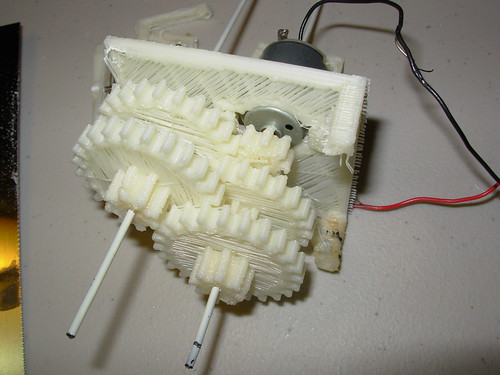
I should note, I have seen that site before. Looking at your comparison pictures, I have a couple of thoughts:
1) I am very aware that machining and casting makes higher quality parts. My point is that for all mechanisms there comes a point where the quality is "good enough".
2) The printed gears you linked to have abysmal quality. My 3 year old printer has made vastly superior parts. See this thingiverse part, with many high quality print examples from home printers:
http://www.thingiverse.com/make:17409
I also used to be of the opinion that CNC machining was so superior as to render 3D printing useless. I looked at those stringy prints and said it would never be useful. But then, I slogged for years making CNC machined parts (see some examples of my parts here: http://www.tlalexander.com/files/portfolio.pdf ) and eventually decided to buy a 3D printer. I make more stuff now than I ever did when I had daily access to a CNC.
But as far as quality - notice how that stringy gearbox you linked to still seems to work? Sure, one is more photogenic, but the goal of a gearbox is to transmit power not win a beauty contents. Meanwhile I have been using a printed gear on my 3D printer's extrusion system for over 2 years with no sign of failure. The application is low speed but medium torque, and I see no wear or signs of weakening. The printed gear satisfied the requirements of the mechanism.
When I think of 3D printing, it reminds me of manufacturing in the 1940's. Parts were clunkier then, like the seat hinge on an old Volkswagen Beetle. But clunky works - often better. Newer techniques might make smaller hinges, but the one from the old beetle still works well. Sometimes higher quality isn't necessary to make something. A designer may choose to make something clunkier so that it can be made at home on a basic printer.
You seemed to suggest that 3D printer is never the ideal way to make something, but of course if I need the part as soon as possible 3D printing usually is.
My long rant about CNC machining was meant to highlight the huge amount of labor involved in machining things. It takes a lot of human skill to write a CNC program (I do expect that to eventually change though) and more labor to set up the machine to get the first part made. In the time it would take me to CNC something I can print a part while I eat a sandwich or run some errands.
Of course 3D prints are slow to produce, but that is counteracted by the fact that it takes less of my involvement to get the parts made. It takes less overall effort to produce a part by print than by machining.
I mentioned metal but the entire story I wrote applies to plastic machining as well - just replace "Campbell Metal" with "Professional Plastics". They're both across from the Fry's off Brokaw.
I totally don't expect most people to have "run into" a time where home 3D printing is best, but you can still do thought experiments. 3D printing is far more accessible to most people than CNC machining is. As home machines get better and we gain more critical mass of users, we will see more designers who take advantage of the stuff that can be made at home. That's what I'm doing with 3D printable robots, and luckily I have a good intersection between people who want to make robots and people who own a 3D printer.
I would say the two key differences between 3D printing and machining is that 3D printing takes zero skill to operate and zero or near-zero labor. Not all home machines have delivered on the ease of use promise of course, but that is an issue with the machines, not the process.
My point is, no other manufacturing technique is well-suited for use at home aside from perhaps laser cutting. The value in printing is of course not the quality of the parts, but the fact that it is a type of manufacturing accessible to consumers. Imagine if Dyson provided printable replacement parts for example, and you can begin to see the value.
Every manufacturing technique has trade offs. A single print takes longer than machining a single part, but with less set-up. Time to first part can often be lower on a 3D printer.
Wrong, wrong and wrong. I'll start with the last "wrong" first. The third wrong (for your statement which only includes two issues) is for the typical, and ill thought process of technology. That it won't change, and it won't get better. It will, and it's doing so by leaps and bounds. 3d printers are quite literally coming out with new processes and equipment every single day. There have been a number of announcements in just the last few months that make it appear that even using metals for at home printing at an affordable rate may be possible in the next five years. There is such a fast rate of change and innovation, it's a bit silly to think that your comments on bad quality and materials won't change within the next year (if those comments were correct, they're not.)
As to materials, literally, every month, there are new materials coming out. At this point, I can use my desktop reprap to print ceramics, PET, Nylon, ABS (to just name a few), and all sorts of hybrids/specific compounds of these plastics designed for 3d printing. Nylon, PET, ABS are good enough for probably ~90% (very rough guess, sorry) of most of the plastic products in your home, it's probably good enough for most of the products I (and many others want to make).
As to precision, that's also quite wrong. The printers are quite precise. They're not as precise as the $75,000 CNC Mill that will get me .001" accuracy, but the truth is that most people don't even need .01" accuracy. And my printer cost me $500, quite a large cost premium there in terms of accuracy (ignoring the importance of cutting metal at this time).
As to doing CNC at home. Even a quite crappy homemade CNC mill, built on a real "mill"(something like a g0704) (not the laughable (to me) desktop mills that have come out recently, which are glorified dremels using similar methods of driving the axis' as a 3d printer, which you can cut aluminum at atrociously slow rates) is going to cost you at least $3000 (machine tools are expensive, not just because of the actual mill, but all the tool holders, bits, cutters, precision vises, calipers, etc. etc. that you also need to make it useful). So yes, a CNC mill is great for alot of things, but that homemade CNC mill isn't really going to hold .001 accuracy either, unless you spend a lot of time working on it and you really know what you're doing.
I'm not going to continue on with this argument, but it seems like your view of 3d printers and CNC milling is quite naive.
My $1500 home CNC will give .001" of an inch of accuracy. You'd be amazed how much errors in the .01s of inches stack up into unusable parts (try doing inlays with wood).
You are quite right that the cost of operation is quite a bit higher though. Bits, collets, spindles, etc really add up. Even with wood, all the tooling is made of solid carbide.
subtractive machining has its benefits though. While printing can make some unattainable shapes, subtractive machining gives a nicer variety of materials, and can be faster.
as to the more mature technology now, CNC definitely has 3D printing beaten, at both scale and precision. Hopefully soon, we'll be able to 3D print carbon fiber parts and then we'll have a real 3d printing boom.
Don't get me wrong, I'm also a machinist, and I do use subtractive machining quite a bit. And I'm guessing your CNC machine is a router, not so much a mill (to make life easier, I'll classify a mill as having a much larger Z-axis movement, and built to deal with harder to machine materials (steel essentially.)) And in that case, it's much easier to get a router to hold smaller tolerances than something that's designed to handle steel. Now I could be totally wrong, and if so, props to you, you got a deal. But really, even the cheap chinese mills (again, talking about something like the Grizzly g0704, maybe the Sieg X2) I've seen that (sans CNC equipment) start at around $1000. And once you add on ball screws, servos, and all the control hardware, you're pushing $1500 easily. And like you said, then you have to actually buy the tools you need to use it.
But while prices on CNC mills are getting cheaper, I'd argue that they aren't declining in price the way that 3d printers are (my reprap cost me $400, my makerbot clone $550). A mini-mill still costs more than it did 10 years ago, with very little improvements to what it does (better motors, electronics, that's about it.)
But to put it simply, I agree with you. Subtractive machining has it's place for sure, but so does 3d printing. But to say that 3d printing sucks, period, is just silly and ignores all the benefits that 3d printing provides. I believe in using the right tool for the job. Sometimes that's old school machining, some times it's 3d printing.
I'll add two quick, somewhat off topic points. It's now (apparently at least, according to GE) easier for them to additive manufacture turbine blades made out of inconel than it is to subtractive manufacture them. I've never had to machine inconel, but from what I've heard, it's quite the difficult thing to do, and most places that machine it, try to cast the part as close to net as possible to make as little machining as possible to do so. But this is something that truly shows the advantages of 3d printing that (might) be better than the traditional way of machining.
The other anecdote is my own. The other day, I was making a part, and for shits and giggles, I took the blueprints, made the part in CAD, printed it out on my 3d printer, and just the act of holding it in my hand and looking at it really helped me think about how to go about machining it out of steel. Most people think "On, CNC is easy, you just throw the file on the machine and it makes the part." It's not that easy, and I was just doing this part on a manual machine. But having that part in my hand really helped me make better decisions on how to best machine the part itself. I thought that was a neat little aspect of 3d printing that I would have never even thought of using it for.


Injection moulding is only lower cost when you want to buy something that is already mass manufactured or millions of identical things. Up to about 10,000 units, 3d printing is cheaper.